Can AI Automate Your Email Marketing for 10x Better Results?
Meta Description
Discover how AI automation for email marketing can transform your business. Learn the step-by-step workflow to automate personalization, timing, and segmentation for unprecedented campaign success.
Introduction
In today’s hyper-competitive digital landscape, capturing and retaining customer attention is paramount. Email marketing, despite its age, remains one of the most potent channels for direct communication and conversion. However, the sheer volume of data, the need for hyper-personalization, and the demand for real-time engagement often overwhelm even the most seasoned marketers. What if there was a way to not only manage these complexities but to leverage them for exponential growth? This article delves into the transformative power of AI automation for email marketing, offering a comprehensive guide for professionals, businesses, agencies, startups, and corporate teams looking to revolutionize their outreach strategies. We’ll explore how artificial intelligence can streamline your workflows, enhance personalization, and drive unprecedented results, moving beyond generic campaigns to truly intelligent, adaptive communication.
Quick Summary (TL;DR)
- AI-driven personalization: Tailor content, offers, and timing to individual subscriber behavior.
- Automated segmentation: Identify high-value audience segments based on deep behavioral patterns.
- Enhanced efficiency: Automate email creation, scheduling, and optimization, freeing up marketing teams.
- Predictive insights: Leverage AI to forecast lead behavior, optimize send times, and recommend next best actions.
- Strategic advantage: Implement intelligent workflows for superior engagement and conversion rates.
Table of Contents
- Introduction
- Quick Summary (TL;DR)
- What You’ll Learn
- Tool Overview: The Power of AI in Email Marketing
- Step-by-Step Tutorial: Implementing AI Automation for Email Marketing
- Step 1: Define Your Goals and Integrate Data Sources
- Step 2: Leverage AI for Advanced Audience Segmentation
- Step 3: AI-Powered Content Generation and Optimization
- Step 4: Setting Up Adaptive Email Nurturing Sequences
- Step 5: Implementing Predictive Send-Time Optimization
- Step 6: Monitoring Performance with AI-Driven Insights
- Visual & UX Enhancement Requirements
- Business Use Cases: How Different Sectors Leverage AI Email Automation
- Best Practices for AI Email Marketing Automation
- Common Mistakes to Avoid in AI Email Marketing
- FAQ Section
- Alternatives to Consider
- Key Takeaways
- Related Guides
What You’ll Learn
- The fundamental principles of integrating AI into your email marketing strategy.
- How AI can automate and optimize audience segmentation, content creation, and campaign management.
- Practical, step-by-step instructions for setting up AI-powered email marketing workflows.
- Insights into leading AI email marketing tools and platforms.
- Strategies for maximizing engagement, conversion, and ROI through AI automation.
- Common pitfalls to avoid and best practices to adopt for sustained success.
Tool Overview: The Power of AI in Email Marketing
AI in email marketing transcends basic automation, employing machine learning algorithms to analyze vast datasets, predict user behavior, and personalize every aspect of your campaigns. This includes everything from crafting compelling subject lines and body copy to optimizing send times and segmenting audiences with unparalleled precision [1]. The goal is to move beyond generic blasts to highly relevant, timely, and engaging communications that resonate with each individual recipient.
Key Features of AI in Email Marketing:
- Personalization at Scale: AI analyzes user data (browsing history, purchase behavior, engagement patterns) to deliver tailored content, product recommendations, and offers.
- Dynamic Segmentation: AI identifies subtle behavioral patterns to create highly specific audience segments that human marketers might miss, leading to more targeted campaigns.
- Content Generation & Optimization: AI assists in generating subject lines, email body copy, and calls-to-action (CTAs) that are optimized for engagement and conversion. It can also translate content for global audiences.
- Predictive Analytics: AI forecasts optimal send times for individual users, predicts lead scores, and identifies potential churn risks, allowing for proactive interventions.
- Workflow Automation: AI automates complex sequences, such as welcome series, abandoned cart reminders, and re-engagement campaigns, adapting them in real-time based on user interactions.
Why Businesses Use It:
Businesses leverage AI in email marketing to achieve higher open rates, click-through rates, and conversion rates. It significantly reduces manual effort, allowing marketing teams to focus on strategy rather than repetitive tasks. Moreover, AI fosters deeper customer relationships by ensuring every communication feels personal and relevant, ultimately driving customer loyalty and lifetime value.
Ideal Use Cases:
- E-commerce businesses seeking to personalize product recommendations and abandoned cart recovery.
- SaaS companies aiming to improve user onboarding, feature adoption, and retention through tailored educational content.
- Agencies managing multiple client campaigns, needing to scale personalization and optimization efforts efficiently.
- Any business looking to enhance customer engagement, streamline marketing operations, and gain a competitive edge through data-driven insights.
Official Websites & Documentation (Examples of leading platforms):
- ActiveCampaign:
- Official Website: https://www.activecampaign.com/
- Official Documentation: https://help.activecampaign.com/
- Encharge:
- Official Website: https://encharge.io/
- Official Documentation: https://encharge.io/knowledge-base/
- **Brevo (formerly Sendinblue):
- Official Website: https://www.brevo.com/
- Official Documentation: https://help.brevo.com/hc/en-us
Step-by-Step Tutorial: Implementing AI Automation for Email Marketing
This section provides a practical guide to integrating AI automation for email marketing into your strategy. Each step is designed to be actionable, explaining the ‘why,’ ‘what,’ and ‘expected result’ to ensure a clear understanding of the process.
Step 1: Define Your Goals and Integrate Data Sources
Why this step matters: Before diving into AI tools, clearly defining your marketing objectives (e.g., increase open rates by 15%, reduce churn by 10%, boost sales by 20%) provides a benchmark for success. Integrating all relevant data sources ensures AI has a comprehensive view of your customer interactions, enabling more accurate predictions and personalization.
What to do:
- Identify Key Objectives: Determine specific, measurable, achievable, relevant, and time-bound (SMART) goals for your email marketing campaigns.
- Audit Existing Data: Catalog all data sources that hold customer information, including your CRM, website analytics, e-commerce platform, and previous email marketing tools.
- Integrate Platforms: Connect these data sources to your chosen AI-powered email marketing platform. Most modern platforms offer native integrations or API access for seamless data flow.
Expected Result: A clear set of campaign goals and a unified customer data profile within your AI marketing platform, ready for analysis.
[SUGGESTED SCREENSHOT:
Dashboard of an email marketing platform showing connected data sources and a section for setting campaign goals.]
Step 2: Leverage AI for Advanced Audience Segmentation
Why this step matters: Traditional segmentation often relies on basic demographics or past purchases. AI-powered segmentation goes deeper, identifying subtle behavioral patterns and micro-segments that are highly predictive of future actions. This allows for hyper-targeted messaging that resonates more deeply with specific groups [1].
What to do:
- Utilize AI-Suggested Segments: Allow your AI platform to analyze your integrated data and propose high-value audience segments based on behavioral patterns (e.g., users who frequently browse specific product categories but haven’t purchased).
- Refine and Test: Review the AI-suggested segments. While AI provides powerful insights, human oversight is crucial. Test different segments with varied messaging to validate AI’s recommendations and fine-tune your approach.
- Dynamic Segmentation Rules: Set up dynamic rules so that contacts are automatically added to or removed from segments based on their real-time behavior, ensuring your audience lists are always up-to-date.
Expected Result: Highly granular and dynamic audience segments that enable personalized campaigns with a higher likelihood of engagement and conversion.
[SUGGESTED SCREENSHOT:
An AI marketing platform’s segmentation interface, displaying AI-suggested segments with behavioral criteria and audience size.]
Step 3: AI-Powered Content Generation and Optimization
Why this step matters: Crafting engaging and effective email content is time-consuming. AI tools can accelerate this process by generating compelling copy, subject lines, and CTAs, and even optimizing them based on predicted performance. This ensures your messages are not only well-written but also strategically designed for impact.
What to do:
- Generate Subject Lines: Use AI to create multiple subject line variations. Provide keywords, desired tone, and emotional triggers. AI can predict which lines will perform best based on historical data.
- Draft Email Body Copy: Input your campaign objectives and key messages into an AI content generator. The AI can produce drafts for different sections of your email, ensuring consistency and relevance.
- Optimize CTAs: Experiment with AI-generated calls-to-action. AI can suggest phrasing that encourages higher click-through rates based on psychological principles and past campaign performance.
- Personalize Content Blocks: Implement AI-driven dynamic content blocks that display personalized product recommendations, relevant articles, or special offers based on individual subscriber profiles.
Expected Result: High-quality, personalized email content generated efficiently, with subject lines and CTAs optimized for maximum engagement.
[SUGGESTED SCREENSHOT:
An email editor within an AI marketing platform, showing AI-generated subject line options and dynamic content blocks.]
Step 4: Setting Up Adaptive Email Nurturing Sequences
Why this step matters: Static drip campaigns often fail to adapt to individual subscriber journeys. AI-powered nurturing sequences are dynamic, adjusting the path and content of emails based on real-time user interactions. This ensures that each subscriber receives the most relevant information at the most opportune moment, guiding them effectively through the sales funnel [1].
What to do:
- Design Core Nurturing Paths: Outline the primary stages of your customer journey (e.g., welcome, engagement, conversion, re-engagement).
- Implement Behavioral Triggers: Configure your AI platform to trigger specific email sequences or content changes based on user actions (e.g., website visits, content downloads, email clicks, inactivity).
- Define Conditional Logic: Use AI to establish rules that dictate how the nurturing sequence adapts. For example, if a user clicks on a pricing page, they might skip educational emails and receive a demo offer instead.
- A/B Test Variations: Continuously test different email variations, subject lines, and sequence flows within your AI-powered automations to identify the most effective paths.
Expected Result: A highly responsive and personalized email nurturing system that adapts to individual subscriber behavior, leading to improved conversion rates and customer satisfaction.
[SUGGESTED SCREENSHOT:
A visual workflow builder in an AI marketing platform, illustrating branching paths based on user actions within an email nurturing sequence.]
Step 5: Implementing Predictive Send-Time Optimization
Why this step matters: Sending emails at the right time significantly impacts open rates and engagement. AI analyzes individual subscriber behavior patterns to determine the optimal send time for each person, ensuring your message lands in their inbox when they are most likely to open and interact with it [1].
What to do:
- Enable Predictive Sending: Activate the predictive send-time optimization feature within your AI email marketing platform.
- Allow Learning Period: Give the AI sufficient time to collect data on individual subscriber engagement patterns (e.g., when they open emails, click links, or make purchases).
- Monitor Performance: Regularly review the impact of predictive sending on your open rates, click-through rates, and conversion metrics. Most platforms provide dashboards to track these improvements.
Expected Result: Increased email open rates and engagement due to emails being delivered at each subscriber’s most receptive time.
[SUGGESTED SCREENSHOT:
An analytics dashboard showing the impact of predictive send-time optimization on email open rates and engagement metrics.]
Step 6: Monitoring Performance with AI-Driven Insights
Why this step matters: Continuous monitoring and optimization are crucial for long-term success. AI provides real-time performance insights, identifies trends, and recommends next-best actions, allowing marketers to quickly adapt strategies and maximize ROI [1].
What to do:
- Access AI Analytics Dashboards: Utilize your platform’s AI-powered analytics to gain deep insights into campaign performance, audience behavior, and content effectiveness.
- Review Performance Reports: Pay attention to AI-generated reports that highlight key trends, anomalies, and areas for improvement (e.g., underperforming segments, high-converting content types).
- Implement Next-Best-Action Recommendations: Act on AI’s suggestions for optimizing campaigns, such as adjusting targeting, refining content, or modifying automation flows.
- Iterate and Refine: Use these insights to continuously iterate on your email marketing strategy, making data-driven adjustments to improve future campaign performance.
Expected Result: A continuously optimized email marketing strategy driven by intelligent insights, leading to sustained improvements in engagement, conversions, and overall marketing effectiveness.
[SUGGESTED SCREENSHOT:
An AI analytics dashboard showing performance metrics, trend analysis, and actionable recommendations for campaign optimization.]
Visual & UX Enhancement Requirements
To make this tutorial highly engaging and easy to follow, consider incorporating the following visual and UX elements:
[WORKFLOW DIAGRAM SUGGESTION:
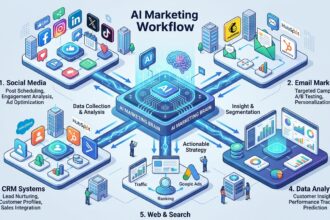
Illustrate the end-to-end AI email marketing automation workflow: Data Integration → AI Segmentation → Content Generation → Adaptive Nurturing → Predictive Sending → Performance Monitoring & Optimization.]
[INFOGRAPHIC SUGGESTION:
Comparison chart showing the benefits of AI-driven email marketing vs. traditional email marketing (e.g., personalization level, efficiency, ROI, engagement).]
[VIDEO EMBED SUGGESTION:
Embed a short walkthrough video demonstrating the setup process of an AI-powered email marketing automation sequence within a platform like ActiveCampaign or Encharge.]
Business Use Cases: How Different Sectors Leverage AI Email Automation
AI email automation is not a one-size-fits-all solution; its applications vary significantly across different business types, each leveraging its capabilities to address unique challenges and opportunities.
Startups
Challenge: Limited resources, need for rapid growth and customer acquisition.
AI Solution: Startups can use AI to automate personalized onboarding sequences, nurture early leads, and segment their nascent customer base for targeted product announcements. This allows them to scale their marketing efforts without a large team, focusing on product development and core business activities.
Agencies
Challenge: Managing multiple client accounts, delivering personalized campaigns at scale, proving ROI.
AI Solution: Agencies can deploy AI to streamline content creation for various clients, automate campaign optimization, and generate performance reports. AI-driven insights help agencies demonstrate tangible results to clients, while automation frees up their teams to focus on strategic client relationships and creative development.
Marketing Teams
Challenge: Overcoming data overload, achieving hyper-personalization, proving marketing’s impact on revenue.
AI Solution: Internal marketing teams can leverage AI for predictive lead scoring, identifying high-intent prospects, and automating adaptive nurturing paths. This ensures that sales-ready leads are handed off promptly and that marketing efforts are directly tied to revenue generation through optimized conversion funnels.
HR Teams
Challenge: Engaging potential candidates, streamlining recruitment communications, improving employee onboarding.
AI Solution: While not directly email marketing, HR teams can adapt AI automation for internal communications. This includes personalized outreach to candidates, automated follow-ups, and tailored onboarding email sequences for new hires, improving candidate experience and employee retention.
Operations Teams
Challenge: Automating customer service communications, managing transactional emails, optimizing operational efficiency.
AI Solution: Operations teams can use AI to automate responses to common customer queries via email, manage order confirmations, shipping updates, and feedback requests. AI ensures these transactional emails are timely, accurate, and personalized, enhancing the overall customer experience and reducing manual workload.
Creators
Challenge: Building and engaging an audience, monetizing content, managing community communications.
AI Solution: Content creators can utilize AI to segment their audience based on content consumption, automate newsletter creation, and personalize promotional emails for courses, merchandise, or premium content. This helps creators build stronger communities and monetize their passion more effectively.
Enterprise Workflows
Challenge: Managing complex customer journeys, integrating with legacy systems, ensuring brand consistency across vast campaigns.
AI Solution: Enterprises can implement AI for sophisticated cross-channel orchestration, ensuring consistent messaging across email, social media, and other touchpoints. AI can also help in managing large-scale data analytics for compliance, identifying global trends, and automating localized content delivery, maintaining brand integrity while scaling operations.
Best Practices for AI Email Marketing Automation
To harness the full potential of AI automation for email marketing, adhere to these best practices:
- Start Small, Scale Gradually: Begin with automating one or two key workflows (e.g., welcome series, abandoned cart) and gradually expand as you gain confidence and see results.
- Maintain Human Oversight: AI is a powerful assistant, not a replacement. Regularly review AI-generated content and insights, and apply human judgment to ensure brand voice, ethical considerations, and strategic alignment.
- Focus on Data Quality: The effectiveness of AI heavily relies on the quality and completeness of your data. Ensure your data sources are clean, integrated, and continuously updated.
- Prioritize Personalization: Use AI to move beyond basic segmentation to true 1:1 personalization. The more relevant your emails are, the higher the engagement.
- Continuously Test and Optimize: AI provides the tools for A/B testing and multivariate testing. Leverage these capabilities to constantly refine your subject lines, content, CTAs, and send times.
- Educate Your Team: Ensure your marketing team understands how to effectively use AI tools, interpret AI insights, and integrate AI into their daily workflows.
- Comply with Regulations: Be mindful of data privacy regulations (e.g., GDPR, CCPA) when collecting and using customer data for AI-driven personalization.
Common Mistakes to Avoid in AI Email Marketing
While AI offers immense benefits, several common pitfalls can hinder its effectiveness. Avoiding these mistakes is crucial for successful AI automation for email marketing.
- Over-reliance on Automation Without Oversight: Blindly trusting AI without human review can lead to off-brand messaging, irrelevant content, or even embarrassing errors. Always have a human in the loop for critical communications.
- Ignoring Data Silos: AI thrives on comprehensive data. Failing to integrate all customer data sources (CRM, website, sales, support) will result in incomplete insights and suboptimal personalization.
- Keyword Stuffing (Even with AI): While SEO is important, forcing keywords unnaturally into AI-generated content will degrade readability and user experience. AI should enhance, not compromise, natural language.
- Neglecting A/B Testing: Assuming AI will always get it right from the start is a mistake. Continuous A/B testing of AI-generated elements (subject lines, CTAs, content variations) is essential for ongoing optimization.
- Lack of Clear Objectives: Without well-defined goals, it’s impossible to measure the success of your AI initiatives. Ensure every AI-driven campaign is tied to specific, measurable outcomes.
- Failing to Update AI Models: AI models need fresh data and occasional recalibration. Neglecting to update or retrain your AI can lead to diminishing returns as customer behavior evolves.
- Treating AI as a Magic Bullet: AI is a tool, not a solution to all marketing problems. It augments human capabilities but requires strategic direction and thoughtful implementation to deliver real value.
FAQ Section
Q1: What is AI automation in email marketing?
A: AI automation in email marketing refers to the use of artificial intelligence and machine learning algorithms to automate, personalize, and optimize various aspects of email campaigns. This includes tasks like audience segmentation, content generation, send-time optimization, and performance analysis, all aimed at delivering more relevant and effective emails to subscribers.
Q2: How does AI personalize email content?
A: AI personalizes email content by analyzing vast amounts of customer data, including past purchases, browsing history, engagement with previous emails, demographic information, and even real-time behavior. Based on these insights, AI can dynamically generate product recommendations, tailor promotional offers, and customize messaging to resonate with each individual recipient.
Q3: Can AI write entire email campaigns?
A: Yes, AI can assist in writing entire email campaigns, from crafting compelling subject lines and preheaders to drafting the main body copy and calls-to-action. Advanced AI tools can even generate full campaign sequences based on a simple prompt, significantly reducing the time and effort required for content creation.
Q4: Is AI email marketing suitable for small businesses?
A: Absolutely. While often associated with large enterprises, AI email marketing tools are increasingly accessible and beneficial for small businesses. They allow small teams to achieve a level of personalization and automation that would otherwise require significant manual effort, helping them compete more effectively and scale their marketing efforts.
Q5: How does AI optimize email send times?
A: AI optimizes email send times by analyzing individual subscriber engagement patterns. It learns when each recipient is most likely to open and interact with emails based on their historical behavior. By delivering emails at these personalized optimal times, AI significantly increases open rates and overall campaign effectiveness.
Q6: What are the main benefits of using AI in email marketing?
A: The main benefits include increased personalization, improved audience segmentation, higher engagement rates (opens, clicks), better conversion rates, reduced manual workload, more efficient campaign management, and data-driven insights for continuous optimization. Ultimately, it leads to a higher return on investment (ROI) for email marketing efforts.
Alternatives to Consider
While the platforms mentioned (ActiveCampaign, Encharge, Brevo) are leaders in AI email marketing, the landscape is rich with other powerful tools, each with its unique strengths.
Mailchimp (with Intuit Assist):
- What it does: A widely popular email marketing platform that has integrated AI capabilities through Intuit Assist. It helps with content generation, subject line optimization, and audience insights.
- When it’s better: Ideal for small to medium-sized businesses already familiar with Mailchimp’s ecosystem, looking for an accessible entry point into AI-powered email marketing without switching platforms.
- Who should use it: Businesses prioritizing ease of use and existing platform integration, especially those already using other Intuit products.
HubSpot (with Content Assistant):
- What it does: A comprehensive CRM platform with robust marketing automation features, now enhanced with AI-powered Content Assistant. It aids in generating email copy, blog posts, and other marketing assets.
- When it’s better: Best for businesses seeking an all-in-one solution where email marketing is tightly integrated with CRM, sales, and service functions. Its AI helps maintain brand consistency across all marketing efforts.
- Who should use it: Growing businesses and enterprises that require a unified platform for marketing, sales, and customer service, and value a holistic view of their customer journey.
Instantly.ai:
- What it does: Specializes in cold email outreach and automation, helping users build winning cold email campaigns and streamline B2B lead generation.
- When it’s better: If your primary focus is on outbound cold email campaigns and lead generation rather than nurturing existing subscribers, Instantly.ai offers specialized features for deliverability and scale.
- Who should use it: Sales teams, B2B businesses, and agencies focused on aggressive lead generation through cold email outreach.
Key Takeaways
- AI is indispensable for modern email marketing: It moves beyond basic automation to intelligent, adaptive, and highly personalized campaigns.
- Data integration is foundational: A unified view of customer data is crucial for AI’s effectiveness in segmentation and personalization.
- Human oversight remains vital: AI augments, but does not replace, human creativity, strategy, and ethical judgment.
- Continuous learning and optimization: AI-driven insights enable ongoing refinement of campaigns for maximum impact.
- The future is intelligent automation: Embracing AI is key to staying competitive and delivering exceptional customer experiences in email marketing.
Related Guides
- How to Master Predictive Analytics in Digital Marketing
- The Ultimate Guide to Hyper-Personalization in Customer Journeys
- Leveraging Machine Learning for Advanced Customer Segmentation
- Building Effective Cross-Channel Marketing Strategies with AI
- A Beginner’s Guide to Marketing Automation Platforms
References
[1] ActiveCampaign. (2026, March 23). AI Marketing Automation in Action: 8 Intelligent Workflows That Turn Data into Real Decisions. Retrieved from https://www.activecampaign.com/blog/ai-marketing-automation