AI Builders

AI Builders

What are AI Builders?

AI Builders refers to the tools, platforms, frameworks, and processes that make it possible to create, customize, deploy, and maintain artificial intelligence applications quickly and reliably. Rather than treating AI as a black box, AI Builders provide the infrastructure, user interfaces, pre-built models, and integrations that let businesses turn AI concepts into production-ready systems — from chatbots and recommendation engines to automated document workflows and synthetic media pipelines.

Why AI Builders matter for business

As AI moves from experiments to core business capabilities, organizations need ways to iterate fast, reduce engineering overhead, and manage risk. AI Builders lower the barrier to entry by offering:

  • Rapid prototyping: build proof-of-concepts and MVPs without months of infrastructure work.
  • Reusability: components, templates, and model marketplaces speed delivery.
  • Operationalization: monitoring, versioning, and deployment pipelines (MLOps) that keep models reliable.
  • Integration: connectors to CRMs, analytics, document stores, and other enterprise systems.
  • Governance & security: controls for data privacy, compliance, and model auditing.

That combination makes AI Builders essential for teams seeking measurable ROI from AI initiatives — whether in customer support, product marketing, HR, or cybersecurity.

Core types of AI Builders

No-code and low-code platforms

No-code/low-code AI Builders let non-engineers assemble intelligent apps from prebuilt blocks. These platforms are ideal for rapid MVPs and internal tooling. Examples include visual app builders, drag-and-drop workflow automation, and model marketplaces.

Developer frameworks and SDKs

For engineering teams, frameworks (like LangChain, LlamaIndex, or SDKs from cloud providers) provide programmatic control to customize prompts, orchestrate pipelines, and implement Retrieval-Augmented Generation (RAG) systems.

Cloud AI platforms & MLOps

Cloud vendors (Google Vertex AI, AWS SageMaker, Microsoft Azure AI) and MLOps tools enable model training, versioning, deployment, monitoring, and scaling — turning prototypes into production services.

Specialized media & agent builders

There are builders focused on domains such as video (Runway, Synthesia), images (generative image platforms), or autonomous agents (multi-agent orchestration frameworks). These reduce time-to-value for specific use cases like marketing videos or virtual assistants.

Common applications and concrete examples

AI Builders are used across industries and functions. Here are practical, real-world examples:

  • Customer support assistant: build a conversational bot that uses RAG over your internal knowledge base to answer queries. Tools: Rasa, Dialogflow, LangChain + Pinecone. (See also AI Agents.)
  • Automated invoice processing: OCR document ingestion (AWS Textract/Google Vision), extraction rules, model-based validation, and a workflow that routes exceptions to humans.
  • Personalized product recommendations: embed-based search + recommendation model deployed via Vertex AI or SageMaker to increase basket size on ecommerce sites.
  • AI-driven marketing videos: use an AI Video builder to generate product demo clips and social ads quickly. Examples: Synthesia, Pictory, Runway. (See category AI Video.)
  • Internal knowledge assistant: combine a vector database with LLMs for instant answers from policy documents, onboarding material, and meeting notes — ideal for improving productivity and training.
  • Prototype MVP apps: use visual builders to assemble an AI-enabled app in days rather than months — from lead scoring front-ends to smart search interfaces.

Tools and platforms — examples to explore

There are many AI Builder tools, each optimized for different stages of the development lifecycle:

  • No-code / low-code app builders: Builder.ai, Bubble, Glide — fast front-end and logic composition for AI-enabled apps. See tag: ai app builder.
  • Prototype / MVP-focused: platforms and templates that accelerate proof-of-concept work. See tag: ai mvp builder.
  • Integration & automation: Zapier, Make, and enterprise integration layers that connect AI services to CRMs and databases. See tag: ai integration tools and category AI Automation.
  • Workflow automation builders: tools that orchestrate AI tasks, human review, and logging — often using no-code interfaces. See tag: AI workflow automation.
  • Media & video builders: Runway, Synthesia, Pictory for AI video generation and editing (useful for marketing teams — see AI Design and AI Video).
  • Developer frameworks: LangChain, LlamaIndex, Hugging Face Spaces for building advanced retrieval, agent orchestration, and custom LLM-powered services.
  • Cloud MLOps: Google Vertex AI, AWS SageMaker, Azure Machine Learning for model training, deployment, observability, and governance.

Best practices when using AI Builders

  • Start with a clear objective: define metrics (accuracy, latency, cost, business KPIs) before you build.
  • Iterate with real data: prototype with representative datasets and include human-in-the-loop reviews to catch edge cases.
  • Plan for integration: connect AI outputs to existing workflows, analytics, and compliance checks — see AI for Business and AI Productivity.
  • Secure and govern: ensure data protection, model explainability, and monitoring to address privacy and security concerns (see AI Security).
  • Measure cost vs. value: optimize model size, serving strategy, and caching to control cloud spend.

Challenges and considerations

AI Builders accelerate development, but teams should be mindful of:

  • Data quality: models are only as good as the data they learn from.
  • Model bias and fairness: evaluate outcomes across user groups.
  • Vendor lock-in: design abstractions so you can swap providers as needs change.
  • Operational complexity: productionizing AI requires observability, retraining pipelines, and ML-aware SRE practices.

Where to learn more and next steps

If you’re exploring AI Builders for your organization, start with a focused pilot that addresses a high-impact pain point (customer support, document automation, or sales enablement). For practical how-tos and case studies, you may find these category pages useful:

For tag-driven deep dives, explore: ai app builder, ai mvp builder, no-code ai tools, ai integration tools, and AI workflow automation.

Conclusion

AI Builders democratize the creation of intelligent systems by combining prebuilt components, integration layers, developer tooling, and operational features. Whether you’re a startup prototyping an MVP, an enterprise scaling recommendation engines, or a marketing team producing AI-generated video, AI Builders shorten time-to-value while helping maintain governance and reliability. Start small, choose the right builder for your use case, and iterate toward measurable business impact.

AI Builders

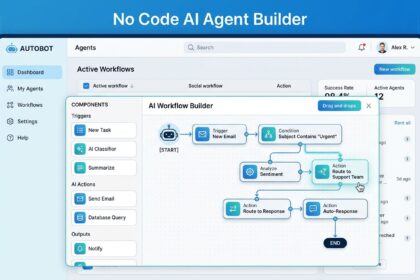
Can You Really Use a No Code AI Agent Builder Without Any Technical Skills?

You have heard that AI agents can automate your business, but every…
NetBix Labs

How Businesses Use AI Website Builders for Faster Launches

Learn how to build a professional business website using an AI website…

Iqbal

How to Create AI Dashboards for Business Operations Without Writing Code

Learn how to build an AI business dashboard for operations, KPI monitoring,…
Iqbal

How Startups Create MVP Apps Faster Using AI MVP Builders

Learn how startups use AI MVP builders, no-code startup tools, and rapid…
Iqbal

How to Build Internal Business Apps with AI Without Coding

Learn how to Build Internal Business Apps with AI Without Codingusing AI…

Iqbal