Learn how startups use AI MVP builders, no-code startup tools, and rapid prototyping AI to launch MVP apps faster with lower costs and less risk.
Introduction
Launching a startup has never been easy.
Founders often spend months planning, hiring developers, refining requirements, and building products before discovering whether customers actually want them. Traditional development cycles can consume significant resources long before market validation occurs.
This is where the rise of the AI MVP builder is changing the startup landscape.
Modern AI-powered application builders allow founders, product teams, agencies, and business professionals to transform ideas into functional applications in days instead of months. By combining artificial intelligence, automation, and no-code startup tools, businesses can rapidly validate concepts, collect user feedback, and iterate faster than ever before.
Whether you’re building a SaaS platform, internal business tool, client portal, marketplace, HR workflow application, or customer-facing mobile app, AI-driven development platforms can significantly accelerate the journey from idea to launch.
In this guide, you’ll learn how startups leverage startup app development AI, modern AI app creation platforms, and rapid prototyping AI workflows to build MVP applications efficiently while reducing development costs and technical complexity.
Quick Summary
- AI MVP builders reduce development time dramatically.
- Startups can validate ideas before investing heavily.
- No-code startup tools enable non-technical founders to build products.
- AI assists with design, database creation, workflows, and logic generation.
- Faster iteration leads to better product-market fit.
- Teams can launch MVPs with smaller budgets.
Table of Contents
- What You’ll Learn
- Understanding AI MVP Builders
- Why Startups Are Adopting AI Development Platforms
- Step-by-Step Guide to Building an MVP Using AI
- Workflow Visualization
- How Businesses Use This Tool
- Best Practices
- Common Mistakes
- Alternative Platforms
- FAQs
- Key Takeaways
- Conclusion
What You’ll Learn
By the end of this article, you’ll understand:
Related guide: How to Build Internal Business Apps with AI Without Coding
- What an AI MVP builder is
- How AI accelerates startup app development
- How to plan an MVP efficiently
- How to create functional prototypes quickly
- How no-code startup tools reduce costs
- How startups validate ideas faster
- How to avoid common MVP development mistakes
- Which AI development platforms are worth evaluating
Understanding AI MVP Builders
What Is an AI MVP Builder?
An AI MVP builder is a software platform that uses artificial intelligence to help users create applications with minimal coding.
You might also like: How to Create AI Dashboards for Business Operations Without Writing Code
These platforms typically allow users to describe an idea using natural language, after which the system generates:
- User interfaces
- Databases
- Workflows
- Business logic
- Forms
- Dashboards
- Automations
Instead of manually building every feature, founders can focus on solving business problems and validating market demand.
Key Features
Modern AI builders commonly include:
- Natural language app generation
- Drag-and-drop interfaces
- Database automation
- AI-generated workflows
- User authentication systems
- API integrations
- Responsive design
- Rapid deployment tools
Why Businesses Use AI Builders
Organizations adopt AI-powered development because they can:
- Reduce development costs
- Launch faster
- Validate ideas earlier
- Improve collaboration
- Reduce technical bottlenecks
- Increase experimentation speed
Ideal Use Cases
AI app creation platforms are ideal for:
- Startup MVPs
- Internal business tools
- HR systems
- Customer portals
- Client dashboards
- Workflow automation
- Operations management
- SaaS product validation
Recommended Platform Example
Official Website:
Official Documentation:
Additional popular options include:
- Bolt.new
- Softr
- Bubble
- FlutterFlow
- Replit
- Glide
Why Startups Are Adopting Startup App Development AI
The startup ecosystem rewards speed.
The faster a company validates assumptions, the lower its risk.
Traditional development often involves:
- Hiring engineers
- Creating specifications
- Building wireframes
- Coding infrastructure
- Testing manually
This process may take several months.
By contrast, startup app development AI allows founders to:
- Build prototypes in hours
- Test ideas quickly
- Collect customer feedback earlier
- Pivot faster
- Preserve capital
This advantage is especially important during early-stage fundraising and product discovery.
Step-by-Step Guide: Building an MVP with AI
Step 1: Define the Core Problem
Why This Matters
Most MVP failures occur because teams build too many features.
The goal of MVP planning is identifying the smallest solution that delivers value.
What To Do
Document:
- User pain point
- Target audience
- Desired outcome
- Core workflow
Example:
Problem:
Small businesses struggle to schedule appointments.
MVP Goal:
Allow customers to book appointments online.
Expected Result
A focused MVP scope that avoids unnecessary complexity.
Step 2: Create User Flows
Why This Matters
User flows help AI builders understand application requirements.
What To Do
Map key actions:
- Sign up
- Login
- Create record
- View dashboard
- Receive notification
Keep workflows simple.
Expected Result
A clear roadmap for app generation.
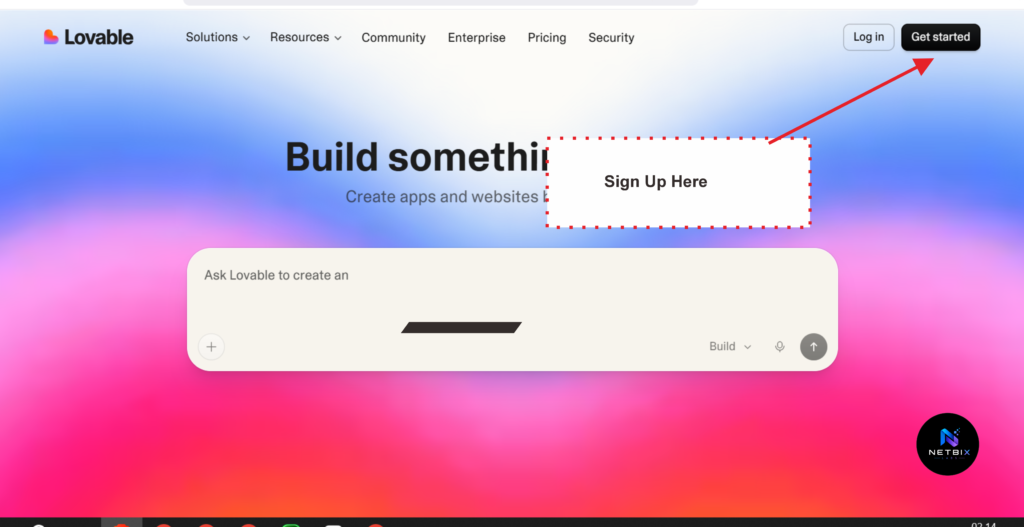
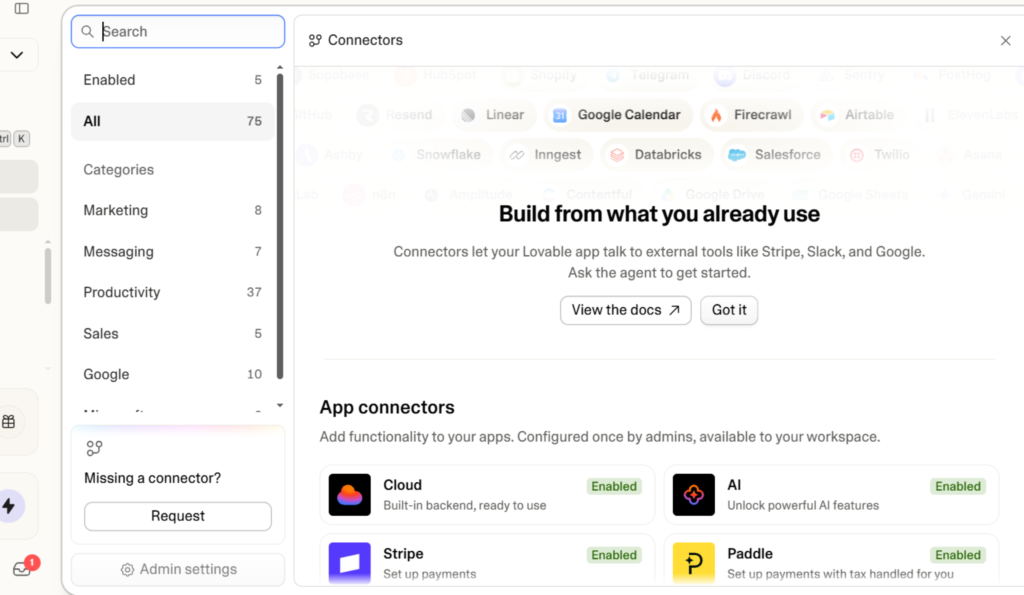
Step 3: Generate the Initial Application
Why This Matters
This is where rapid prototyping AI delivers the biggest advantage.
What To Do
Use prompts such as:
Build an AI-powered appointment booking SaaS platform for small businesses.
Features:
– Secure authentication
– Customer accounts
– Online booking forms
– Real-time calendar scheduling
– Automated appointment reminders
– Admin dashboard
– Customer database
– Service catalog
– Booking history
– Analytics and reportingAutomatically generate:
– Application pages
– Responsive layouts
– Database architecture
– Backend logic
– User workflows
– Dashboard componentsCreate a professional, startup-ready MVP that can be customized and launched quickly.
Expected Result
A functional application foundation.
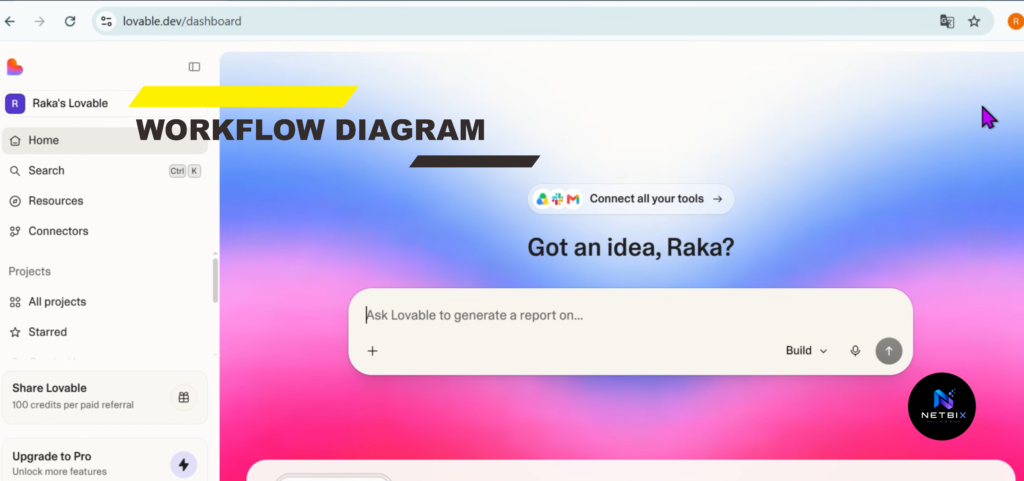
Step 4: Customize Business Logic
Why This Matters
Generated applications require customization.
What To Do
Adjust:
- User permissions
- Database fields
- Forms
- Notifications
- Automation rules
Examples:
- Email confirmations
- Team notifications
- Lead assignments
Expected Result
A more realistic MVP aligned with business needs.
Step 5: Test with Real Users
Why This Matters
User feedback drives product improvement.
What To Do
Invite:
- Customers
- Team members
- Stakeholders
- Beta testers
Track:
- User behavior
- Feedback
- Feature requests
- Pain points
Expected Result
Validated assumptions and actionable insights.
Step 6: Iterate Rapidly
Why This Matters
Iteration is where successful startups outperform competitors.
What To Do
Review:
- Usage analytics
- Drop-off points
- Feature adoption
Prioritize:
- High-impact improvements
- Frequently requested features
Expected Result
Continuous product improvement.
Step 7: Launch Publicly
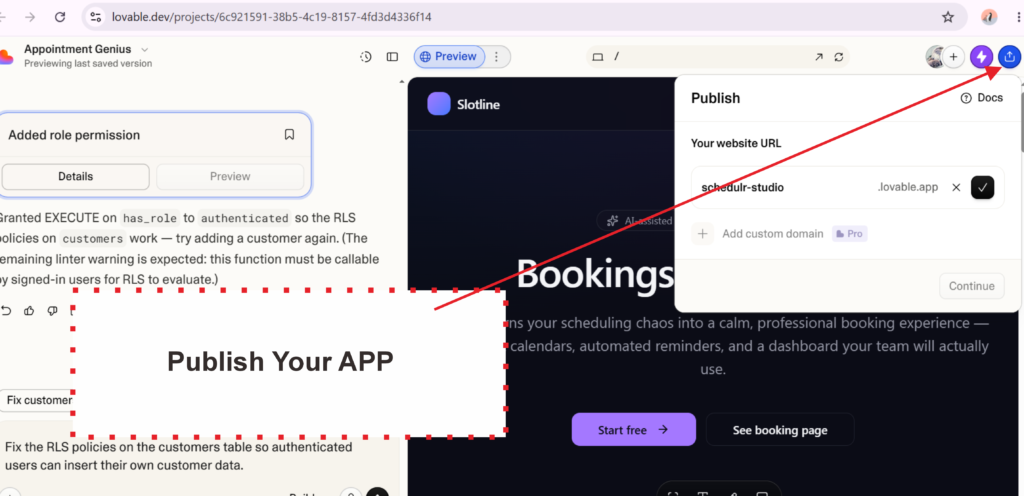
Why This Matters
The market provides the most valuable feedback.
What To Do
Deploy the MVP.
Collect:
- Signups
- Conversion rates
- Customer interviews
- Revenue data
Expected Result
Real-world product validation.
Workflow Visualization
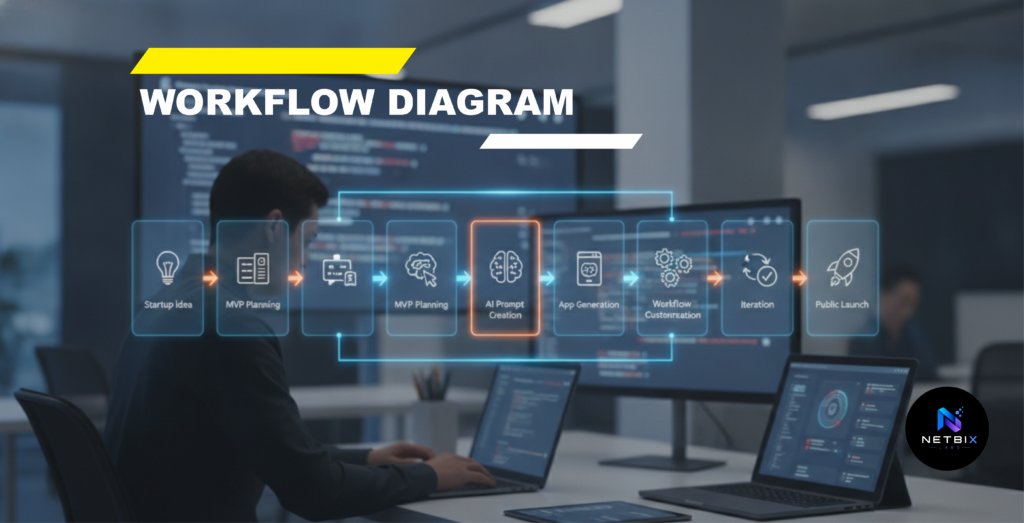
Startup Idea → MVP Planning → AI Prompt Creation → App Generation → Workflow Customization → User Testing → Iteration → Public Launch]
Traditional Development vs AI MVP Builder
Traditional:
Requirements → Design → Development → QA → Launch
AI Builder:
Idea → Prompt → Generated App → Test → Launch
Include estimated timelines and resource comparison.]
Video Tutorial
We’ve provided a very easy-to-follow video tutorial. You can follow the step-by-step process of creating an app with AI in this video.
How Businesses Use This Tool
Startups
- SaaS validation
- Marketplace MVPs
- Subscription products
- Mobile applications
Agencies
- Client prototypes
- Internal dashboards
- Campaign management tools
Marketing Teams
- Lead generation portals
- Customer onboarding workflows
- Event registration systems
HR Teams
- Employee onboarding systems
- Internal requests portals
- Training management platforms
Operations Teams
- Inventory workflows
- Process automation
- Approval systems
Creators
- Membership platforms
- Content portals
- Community applications
Enterprise Workflows
- Internal business tools
- Department automation
- Process digitization initiatives
Best Practices
Focus on One Core Problem
Avoid feature overload.
Validate Before Scaling
Test demand before investing heavily.
Use Analytics Early
Measure behavior from day one.
Prioritize User Feedback
Customer insights should guide development.
Keep MVP Planning Simple
The simplest version often produces the best learning outcomes.
Automate Repetitive Tasks
Use AI-generated workflows to reduce manual work.
Common Mistakes
Building Too Many Features
Solution:
Focus on one primary use case.
Ignoring Customer Feedback
Solution:
Conduct interviews and surveys regularly.
Choosing the Wrong Tool
Solution:
Evaluate platform capabilities before committing.
Delaying Launch
Solution:
Release early and improve continuously.
Not Tracking Metrics
Solution:
Implement analytics immediately.
Over-Customizing Too Soon
Solution:
Validate demand before extensive development.
Alternatives to AI MVP Builders
Bubble
What It Does:
Visual no-code application builder.
When It’s Better:
Complex workflows and mature SaaS applications.
Best For:
Founders building scalable web applications.
FlutterFlow
What It Does:
Visual mobile application builder.
When It’s Better:
Native mobile experiences.
Best For:
Startups launching iOS and Android products.
Softr
What It Does:
Transforms databases into business applications.
When It’s Better:
Internal tools and portals.
Best For:
Small businesses and operational teams.
Glide
What It Does:
Creates apps from spreadsheets.
When It’s Better:
Rapid internal tool development.
Best For:
Non-technical teams.
Replit
What It Does:
AI-assisted coding environment.
When It’s Better:
Developers needing more customization.
Best For:
Technical startup teams.
Frequently Asked Questions
What is an AI MVP builder?
An AI MVP builder is a platform that uses artificial intelligence to generate applications, workflows, and interfaces from natural language prompts.
Can non-technical founders build apps using AI?
Yes. Many no-code startup tools are designed specifically for non-technical founders and business professionals.
How fast can an MVP be built?
Simple MVPs can often be created within hours or days instead of months.
Is AI-generated code production ready?
It depends on the platform. MVP validation is typically the primary objective before production optimization.
What industries benefit most from AI app creation?
SaaS, healthcare, HR, education, finance, marketing, operations, and e-commerce frequently benefit.
How does rapid prototyping AI reduce costs?
It minimizes manual development effort, shortens project timelines, and reduces dependency on large engineering teams.
Which AI builder is best for startups?
The best platform depends on the application type, technical requirements, budget, and scalability needs.
Do AI MVP builders replace developers?
Not entirely. They accelerate development and validation but experienced developers remain valuable for scaling and advanced customization.
Key Takeaways
- AI MVP builders dramatically shorten development timelines.
- Startup app development AI helps founders validate ideas faster.
- No-code startup tools lower technical barriers.
- Rapid prototyping AI improves experimentation.
- Early user feedback is critical.
- MVP planning should focus on solving one problem well.
- Faster validation reduces startup risk.
- AI-powered app creation is becoming a competitive advantage.
Conclusion
The rise of the AI MVP builder represents one of the most significant shifts in modern product development.
Instead of spending months building before validating demand, startups can now leverage startup app development AI, AI app creation platforms, and rapid prototyping AI tools to move from idea to market in a fraction of the time.
For founders, agencies, HR leaders, and business teams, the opportunity is clear: launch faster, learn faster, and adapt faster.
Organizations that embrace AI-powered development workflows today are positioning themselves to innovate more efficiently, reduce costs, and discover product-market fit before competitors. As no-code startup tools continue to evolve, rapid MVP creation will become a standard part of modern business innovation.