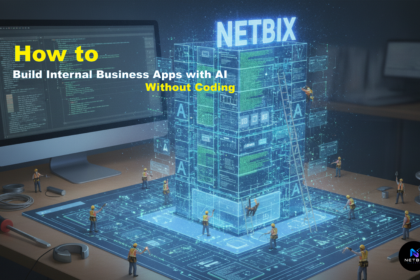
How to Build Internal Business Apps with AI Without Coding
Learn how to Build Internal Business Apps with AI Without Codingusing AI…

AI business systems are integrated software applications and platforms that embed artificial intelligence to automate, optimize, and augment core business processes. These systems combine data, machine learning models, orchestration layers, and user-facing interfaces to deliver smarter workflows across sales, customer service, finance, HR, supply chain, security, and product development. In short, an AI business system turns raw business data into automated actions, predictions, and insights that improve speed, accuracy, and decision-making.
Adopting AI business systems is no longer optional for competitive enterprises. They drive tangible benefits including cost reduction, faster cycle times, improved customer experiences, and better forecasting. AI systems help businesses:
AI business systems power intelligent chatbots, lead scoring, and sales forecasting. Examples include conversational agents that triage customer requests, recommendation engines that improve cross-sell, and predictive lead-scoring models that prioritize high-value prospects. Tools like Salesforce Einstein and CRM integrations with GPT-based copilots enable sales teams to automate outreach and generate personalised proposals.
AI helps automate invoicing, reconcile accounts, detect anomalies, and forecast cash flow. Systems embed OCR, NLP, and anomaly detection to accelerate month-end close and reduce manual errors. Platforms such as UiPath (RPA) and solutions leveraging cloud ML services streamline reconciliation and financial reporting.
Use cases include demand forecasting, route optimization, predictive maintenance for machinery, and dynamic pricing. Enterprises can reduce stockouts and overstock while improving on-time delivery. Cloud ML offerings like AWS SageMaker or Google Cloud Vertex AI are often used to build and deploy these models.
AI business systems support candidate screening, skills matching, workforce planning, and employee sentiment analysis. Intelligent assistants can automate interview scheduling and surface internal mobility opportunities.
AI systems analyze logs, detect unusual behavior, and automate incident response. Solutions from specialized providers and in-house models augment SIEM systems to reduce dwell time and prioritize threats. See also our category on AI Security for related strategies.
Generative AI streamlines ad creative production, content personalization, and campaign optimization. Marketers use AI to test variations at scale and personalize messaging. Explore ideas in our AI Design and AI Video categories.
Autonomous AI agents—software that can take multi-step actions across systems—are emerging as a major component of AI business systems. These agents combine planning, APIs, and automation to execute complex tasks like end-to-end order fulfillment or multi-channel customer resolution. For practical guidance, see our AI Agents and AI Automation categories, and related tags like ai agents automation and ai agents business.
Successful AI deployments follow a pragmatic path:
Adopt a balanced approach: combine speed-to-market (using pre-built AI services) with robust governance (privacy, explainability, security). Collaborate across IT, data science, and business units to avoid siloed pilots. Refer to our AI for Business and AI Productivity categories for frameworks and case studies.
Expect increased adoption of generative AI to produce content and code, more autonomous AI agents orchestrating multi-step workflows, widespread embedded AI in everyday business systems, and stronger emphasis on responsible AI. For analytics-driven teams, dashboards and model-driven decisioning will continue to converge — see our tag on ai analytics dashboard for related topics.
Explore related categories and tags to deepen your understanding of AI business systems:
AI business systems are transforming how companies operate—automating tasks, unlocking insights, and enabling smarter customer and employee experiences. Start with a focused use case, pick the right platform, and scale with governance to realize sustainable business value.
Learn how to Build Internal Business Apps with AI Without Codingusing AI…