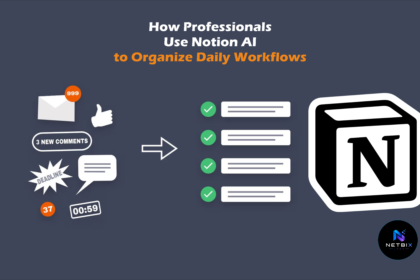
How Professionals Use Notion AI to Organize Daily Workflows
Learn how to use Notion AI to organize your daily workflows, automate…

AI task management refers to the use of artificial intelligence technologies to create, prioritize, assign, schedule, optimize, and track tasks across teams, projects, and workflows. Rather than treating tasks as static checklist items, AI task management systems apply machine learning, natural language processing, predictive analytics, and automation to understand context, predict timelines, and act on tasks—either by suggesting actions to humans or executing them autonomously via agents and automation rules.
Modern work is more distributed, interdependent, and time-sensitive than ever. Teams struggle with overloaded calendars, unclear priorities, missed deadlines, and repetitive coordination tasks. AI task management solves these problems by:
Several commercial tools mix traditional task management with AI features; others are pure AI-native platforms or agent frameworks:
During a product launch, AI task management can:
AI can triage incoming tickets into tasks, route them to the right teams, suggest responses, and automatically escalate high-priority cases. Integration with CRM and analytics platforms allows AI to create tasks for follow-ups and predict customer churn based on unresolved issues.
AI task management often sits at the intersection of several AI categories. It leverages AI Agents to perform autonomous steps, uses AI Automation for workflows and rules, and benefits from AI Builders when teams create custom task bots and integrations. For creative handoffs, it connects to AI Design and AI Video tools; for company-wide adoption it aligns with AI for Business strategies and AI Productivity initiatives. Security and governance should reference AI Security best practices.
Explore practical guides and tool roundups that complement AI task management: ai agents automation, ai agents workflow, ai agents business, and agency ai tools.
While AI task management can be transformative, teams must consider:
Expect AI task management to evolve with more autonomous agents that can complete entire workflows end-to-end, deeper integrations into communication platforms, and predictive systems that not only flag risks but also propose and execute remediation plans. Advances in multi-modal models and domain-specific builders will let organizations craft custom task agents that understand specialized terminology and processes.
AI task management is a practical, high-impact application of AI that addresses the everyday fracturing of work by turning raw conversations and data into prioritized, scheduled, and sometimes autonomous action. Whether you’re a small agency leveraging smart scheduling and creative automation, or an enterprise adopting agents and RPA, applying AI thoughtfully to task management drives productivity, reduces friction, and helps teams focus on higher-value work.
Learn how to use Notion AI to organize your daily workflows, automate…