You have probably seen the headlines claiming AI agents for small business can replace five employees overnight, but the data tells a different story — one that separates USD 7 billion in market hype from the 5% of pilots that actually deliver measurable returns.
The Hard Truth About AI Agents for Small Business in 2026
The agentic AI market hit USD 7.06 billion in 2025, and it is projected to grow to USD 93.2 billion by 2032, according to MarketsandMarkets.
Yet Gartner predicts that over 40% of agentic AI projects will be canceled by the end of 2027.
That gap — between explosive investment and massive cancellation — is where the real story of AI agents for small business lives.
Most small business owners I speak with fall into two camps: those who believe AI agents are magic, and those who believe they are overpriced chatbots.
Both are wrong.
What the Statistics Actually Say About Adoption
The Google Cloud ROI of AI Study (September 2025, surveying 3,466 senior leaders across 24 countries) found that 52% of executives say their organization is actively using AI agents, and 39% have already deployed more than ten.
But here is the part that does not make the press release: the same study found that only among early adopters of agentic AI — those who deployed agents for at least one specific, measured use case — did 88% report a return on investment.
Among everyone else, the number dropped significantly.
BCG’s Widening AI Value Gap report (September 2025, surveying more than 1,250 companies) delivered an even starker finding: only 5% of companies are capturing significant value from AI at scale, while roughly 60% are capturing no material value at all.
This is not because AI agents do not work.
It is because most businesses deploy them wrong.
The Only Pattern That Works: Narrow Agents for Narrow Problems

MIT’s Project NANDA report, The GenAI Divide: State of AI in Business 2025, concluded that despite an estimated USD 30 to 40 billion in enterprise spending on generative AI, 95% of organizations are getting no measurable return.
Only 5% of custom AI pilots ever reach production, even though more than 80% of firms have piloted tools like ChatGPT or Copilot.
The MIT report also found a striking split in how companies succeed: buying AI tools from specialized vendors and building partnerships succeeded about 67% of the time, while internally-built tools succeeded only about one-third as often.
The lesson is clear: focused, bought-in agents tend to work where sprawling internal builds do not.
For small businesses, this means one thing: do not try to build your own AI agent from scratch.
Buy a proven one that does one thing well.
Why Most AI Agents for Small Business Fail Before They Start
Gartner’s June 2025 forecast predicting over 40% of agentic AI projects will be canceled by end of 2027 cited three root causes: escalating costs, unclear business value, and inadequate risk controls.
Gartner’s Anushree Verma described most current projects as “early stage experiments or proof of concepts that are mostly driven by hype and are often misapplied.”
There is another problem the reports do not name directly: agent washing.
Gartner estimates that of the thousands of companies marketing agentic AI, only about 130 are real.
The rest are rebranding existing chatbots, assistants, and robotic process automation as agents without genuine agentic capability.
Small business owners who buy into agent washing end up with expensive chatbots and conclude that AI agents do not work.
The technology was never the problem — the purchase was.
Where AI Agents for Small Business Actually Deliver ROI
Customer service is the most proven use case.
Gartner predicts that by 2029, agentic AI will autonomously resolve 80% of common customer service issues without human intervention, leading to a 30% reduction in operational costs.
The most-cited real-world deployment is Klarna. In its first month live (February 2024), Klarna’s OpenAI-powered assistant handled 2.3 million conversations — about two-thirds of the company’s customer service chats — did the work of 700 full-time agents, and cut average resolution time from 11 minutes to under 2 minutes.
Klarna projected a USD 40 million profit improvement for 2024.
But here is the honest part of the Klarna story that most articles leave out: by 2025, after customer satisfaction dipped, Klarna began rehiring human agents, with CEO Sebastian Siemiatkowski conceding that cost-driven automation had produced “lower quality” and promising customers would “always have a human if you want.”
The durable win came later: by Q3 2025, Klarna reported its AI doing the work of 853 agents and about USD 60 million in annual cost savings, framed as avoided hiring during growth rather than layoffs.
The arc — big launch, public correction, durable but smaller win — is the most useful case study available for any small business evaluating AI agents.
The Cost Reality: What Small Businesses Actually Pay
According to recent industry analysis, AI agent costs range from USD 150 to USD 3,000 per month depending on complexity and channel coverage.
Basic setups deploy in 5–7 days.
Advanced integrations take 2–4 weeks.
For a typical small business, that is 15 to 20 hours a week of manual work redirected toward something that actually moves the business forward, according to multiple deployment case studies.
Digital workflow automation saves employees up to 20 hours per week, according to a 2025 analysis of AI workflow deployment outcomes.
AI adoption in small businesses boosts productivity by 29–72%, depending on the use case and implementation quality.
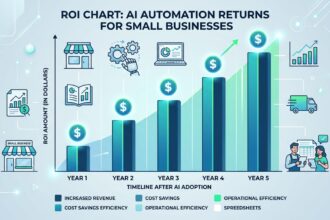
The ROI math is simple: if an AI agent costs USD 500/month and saves 15 hours of manual work per week at USD 25/hour, the monthly return is roughly USD 1,500 against the USD 500 cost.
That is a 3x return in the first month.
But only if the agent is deployed in the right use case.
Real Use Cases That Work Today

Based on deployment patterns from companies that actually see returns, here are the use cases where AI agents for small business deliver measurable results right now:
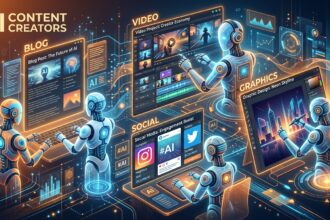
Customer support triage. AI agents handle Tier 1 inquiries — order status, business hours, return policies — and escalate only when the conversation requires human judgment.
Lead qualification and follow-up. Agents research prospects, update CRM records, draft personalized outreach emails, and schedule follow-up calls without human intervention between steps.
Invoice processing and data entry. Agents extract data from invoices, match them against purchase orders, and flag discrepancies for human review.
Social media DM management. Industry data shows that businesses using AI agents for social messaging see median response times under 15 seconds, compared to hours or days for manual management.
Content summarization and research. Agents scan competitor content, summarize industry reports, and prepare briefing documents that would take a human hours to compile.
Each of these use cases follows the same pattern: one narrow, high-volume task with a clear success metric.
The 5% That Works vs. The 40% That Gets Canceled
PwC’s 2026 AI Business Predictions reports that companies using agents cited 66% productivity gains and 57% cost savings among the benefits.
But PwC also noted that many agentic deployments in 2025 “didn’t deliver much value,” often because agents were not applied to value-producing work, or because demos had, in PwC’s words, “nothing to see.”
What separates the 5% that work from the 40% that get canceled is not the technology.
It is the deployment strategy.
The projects that fail tend to be broad, internally-built, hype-driven experiments dropped on top of legacy systems.
The ones that work tend to be narrow, bought-in, and pointed at a specific high-volume task with a clear value metric.
Gartner’s own advice in the cancellation release is to pursue agentic AI “only where it delivers clear value or ROI.”
MIT’s data backs that up quantitatively: bought-from-vendor agents succeed roughly twice as often as internal builds.
Watch: How Small Businesses Are Using AI Agents to Replace 5-Person Teams
This video provides a practical walkthrough of how real small businesses deploy AI agents for customer service, lead management, and operations:
The Verdict: Should You Invest in AI Agents for Small Business?
The answer is yes — but only if you follow the pattern that works.
Do not try to automate your entire business at once.
Pick one high-volume, repetitive task that consumes at least 10 hours of someone’s week.
Buy a proven agent from a specialized vendor, not a general-purpose chatbot repackaged as an agent.
Measure one metric — response time, cost per lead, hours saved — before and after deployment.
If the ROI is positive in 30 days, expand to the next use case.
The U.S. Census Bureau’s Business Trends and Outlook Survey found that 47% of small businesses used AI in some capacity in 2025, up from roughly 40% in 2024.
The SBE Council’s March 2026 data finds the average small business uses a median of five AI tools.
The adoption curve is real, and it is accelerating.
But the businesses that win are not the ones that adopt AI agents first.
They are the ones that adopt them right.