Tag: Ai Content Creation Business

Ai Content Creation Business

What “AI Content Creation Business” Means

The term AI content creation business refers to companies, teams, or services that use artificial intelligence to generate, optimize, distribute, or manage content at scale. That content can include blog posts, landing pages, ad copy, social media posts, images, videos, audio, product descriptions, and more. An AI content creation business blends human editorial strategy with machine learning models—like large language models (LLMs), image generators, and multimodal systems—to speed production, reduce cost-per-item, and personalize content for specific audiences.

Why AI Content Creation Matters for Business

AI-driven content creation is transforming how companies approach marketing, customer education, and internal knowledge management. Key reasons it matters:

  • Scale: Produce thousands of product descriptions or localized landing pages quickly.
  • Speed: Shorten ideation-to-publish cycles from days to hours.
  • Cost-efficiency: Reduce repetitive human labor for first drafts and templated assets.
  • Personalization: Deliver tailored messages across segments using data-driven prompts and templates.
  • Experimentation: Generate variants for A/B testing creative concepts and ad copy.

Key Applications and Use Cases

AI content creation businesses apply AI across a broad spectrum of tasks. Common applications include:

Marketing & Advertising

  • Automated ad copy and creative variants for performance marketing, improving CTR and conversion tests.
  • Dynamic social media posts adapted to channel and audience.
  • AI-assisted creative production for ads (see AI ad creatives).

SEO & Content Marketing

  • Topic research, content briefs, and first-draft generation for blogs and guides.
  • On-page optimization suggestions to match search intent and target keywords.

Product & E-commerce

  • Bulk product descriptions and attribute-based content generation.
  • Localized content for different markets and languages.

Video, Audio & Design

  • Script writing for videos, automatic rendering of video using AI video platforms, and automated voiceover generation.
  • AI-generated visuals and creative assets for thumbnails, social posts, and presentations.

Customer Support & Knowledge

  • AI-summarized documentation, knowledge base articles, and chatbot responses that help scale support.
  • AI agents that can draft customer-facing messages or escalate issues to humans (see AI Agents and ai agents automation).

Concrete Tools and Real-World Examples

Several platforms and tools power AI content creation businesses. Examples include:

  • OpenAI GPT (ChatGPT/GPT-4): Used for drafting articles, ad copy, email sequences, and chatbots.
  • Jasper, Copy.ai, Writesonic: SaaS tools tailored to marketers for rapid content drafting and templates.
  • Surfer SEO, Frase, MarketMuse: Combine AI copy with SEO research and optimization guidance.
  • Canva AI & Adobe Firefly: Generate and edit visuals and layout assets for marketing creative.
  • Synthesia, Descript, Pictory, Lumen5: Convert scripts into videos and automated visual narratives.
  • Murf.ai, Resemble.ai: Produce realistic AI voiceovers for explainer videos and podcasts.
  • Auto-GPT, AgentGPT: Emerging agent frameworks that automate end-to-end workflows—useful for long-running content tasks (see ai agents business).
  • Zapier, Make, native APIs: Integrate AI content tools with CMS, CRM, and analytics for automated publishing and tracking (related to AI Automation).

How Businesses Implement AI Content Creation

Implementation typically follows a hybrid workflow where AI handles heavy lifting while humans provide strategy and quality control:

  • Define templates & prompts: Brand voice, content structure, and SEO targets are encoded into prompts and templates.
  • Automate content pipelines: Integrate AI with CMS, DAM, and marketing platforms to draft, review, approve, and publish.
  • Human-in-the-loop: Editors refine AI drafts, fact-check, and infuse brand nuance.
  • Measure & iterate: Use analytics to optimize prompts, headlines, thumbnails, and calls to action; connect insights to content production via AI Productivity.

Benefits, Risks, and Best Practices

Benefits

  • Faster content cycles and higher output.
  • Lower marginal costs for templated content.
  • Improved personalization and multivariate testing capability.

Risks & Challenges

  • Quality inconsistencies and hallucinations from models—requires human review.
  • Potential copyright or licensing concerns with training data and generated media.
  • Brand voice drift if prompts aren’t standardized.
  • Regulatory and ethical considerations around transparency and synthetic media (AI Security overlaps here).

Best Practices

  • Maintain a strong human-in-the-loop editorial process for accuracy and tone.
  • Version-control prompts and templates to ensure repeatability.
  • Test AI-generated variants against human-created control in real campaigns.
  • Document provenance and usage policies for synthetic media and customer-facing content.
  • Leverage specialized tools for the content type — e.g., Surfer for SEO, Synthesia for video, Murf for voice.

Related Categories and Tags

AI content creation intersects with many AI-driven fields. Explore these related categories for deeper practical guidance:

  • AI for Business — strategy and transformation case studies.
  • AI Automation — connecting content workflows to systems and triggers.
  • AI Design — visuals, layouts, and brand creative with AI.
  • AI Video — automated video creation and distribution.
  • AI Productivity — tools and workflows that increase team output.

Relevant tags for hands-on tools and agency workflows include:

Conclusion

An AI content creation business combines technology, creative strategy, and operational workflows to produce content faster and at scale. The most successful implementations balance automation with human oversight, integrate AI into existing systems, and continuously measure outcomes to improve prompts and models. Whether you’re an agency generating ads and social campaigns, an e-commerce brand automating product pages, or an enterprise building knowledge assistants, AI content creation is a practical lever to increase reach, reduce costs, and accelerate experimentation.

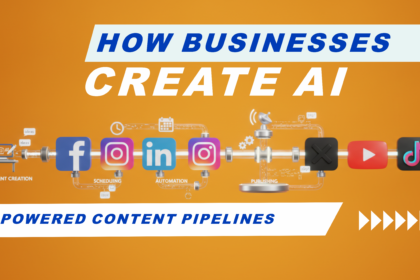
How Businesses Create AI-Powered Content Pipelines

Learn how businesses build AI-powered content pipelines using Buffer — from ideation…

Iqbal