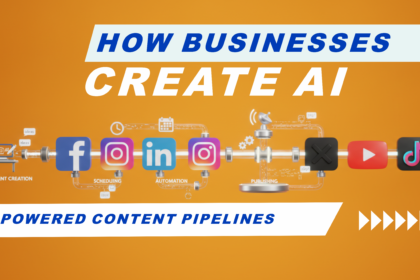
How Businesses Create AI-Powered Content Pipelines
Learn how businesses build AI-powered content pipelines using Buffer — from ideation…

An AI content pipeline is a structured sequence of tools, models, and processes that take raw data or ideas and transform them into publishable content using artificial intelligence. Instead of a single-generation step, a content pipeline breaks the workflow into stages—research, ideation, drafting, editing, optimization, publishing, and measurement—often automating or augmenting each stage with AI components. The result is faster, more consistent, and measurable content production for marketing, product documentation, knowledge bases, social media, and more.
Businesses adopt AI content pipelines for three main reasons:
Well-designed pipelines reduce time-to-publish and support cross-functional teams—marketing, product, sales, and support—by providing consistent, on-brand assets.
Modern AI content pipelines combine LLMs, orchestration frameworks, and domain tools. Common components include:
AI content pipelines are used across industries and formats. Here are concrete examples:
Start small and iterate. A typical rollout follows these steps:
AI content pipelines intersect with many AI disciplines. Explore related topics for implementation guidance and inspiration:
Relevant tag deep-dives:
An AI content pipeline is more than a set of point solutions—it’s a repeatable system that combines AI models, orchestration tools, and human oversight to produce higher-quality content at scale. By designing modular pipelines, enforcing governance, and closing the loop with analytics, businesses can unlock predictable content velocity and measurable ROI. For teams exploring implementation, start with a single content type, instrument performance, and expand the pipeline as confidence and results grow.
Learn how businesses build AI-powered content pipelines using Buffer — from ideation…