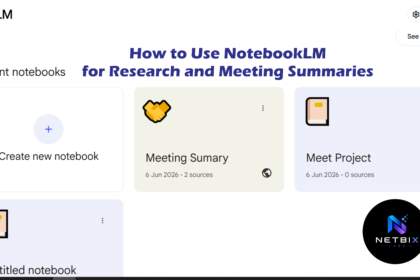
How to Use NotebookLM for Research and Meeting Summaries
Learn how to use NotebookLM as an AI research assistant and meeting…


AI research tools are software platforms, libraries, and services that help researchers, data scientists, and engineers design, train, evaluate, and deploy artificial intelligence and machine learning models. These tools span the full research lifecycle: literature discovery, data collection and labeling, prototyping, experiment tracking, reproducibility, model evaluation, and deployment. In short, they turn ideas into reproducible experiments and production-ready systems.
High-quality AI research tools accelerate innovation by reducing friction around routine tasks, improving collaboration, and enabling rigorous, reproducible work. For organizations and teams, these tools are essential to:
Before building models, researchers survey prior work. Tools in this category include:
Frameworks and environments for building models quickly:
Data quality is central to research validity. Tools include:
To manage experiments, hyperparameters, and deployments:
Robust evaluation and safety tooling matter for responsible research:
AI research is increasingly collaborative. Tools that enable sharing and reproducible artifacts include:
Below are practical examples showing how research tools are used in business and academic settings.
A startup uses Hugging Face Transformers and PyTorch Lightning to fine-tune a BERT model on a domain-specific corpus. They track experiments with Weights & Biases and store datasets with DVC. This accelerates iteration and produces a well-documented, deployable classifier that the product team can review.
An enterprise migrates from notebooks to a repeatable pipeline: data ingestion runs on Databricks, models are trained with TensorFlow in managed clusters on Amazon SageMaker, and experiments are logged through MLflow. Monitoring and rollback policies help comply with governance requirements in regulated industries (AI for Business and AI Security).
Research teams use Papers with Code and Connected Papers to quickly find state-of-the-art methods, reproduce baselines, and build on top-performing models. This prevents duplicate work and speeds up publication-ready experiments.
Teams experimenting with autonomous workflows combine tools like LangChain or custom AI Agents frameworks with automated evaluation pipelines. This links experimental agents to automated tests and CI systems to validate behavior in simulated environments, tying into AI Automation efforts.
Choosing tools depends on your goals, team size, and lifecycle stage. Consider:
AI research tools are not isolated — they feed into product design, marketing, and operations. For example:
Explore complementary content and tools via related tags:
AI research tools are the backbone of modern machine learning and AI innovation. Whether you are an academic researcher, a data scientist in an enterprise, or a startup building an AI product, selecting the right mix of literature discovery, prototyping frameworks, labeling platforms, experiment trackers, and MLOps systems will determine how quickly and reliably you can go from idea to impact. Explore the linked categories and tags to find practical guides, tool reviews, and case studies that match your project needs.
Start by identifying the stage of your project (research, prototyping, or production), then pick complementary tools that emphasize reproducibility, collaboration, and scalability.
Learn how to use NotebookLM as an AI research assistant and meeting…