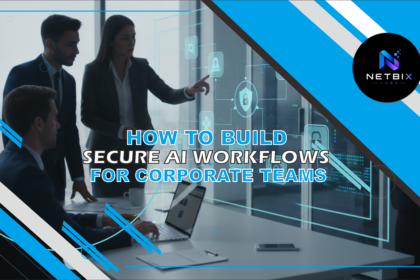
How to Build Secure AI Workflows for Corporate Teams
Your team is already using AI — but without a clear policy,…

Secure AI workflows are end-to-end processes for building, deploying, and operating AI systems that integrate security, privacy, compliance, and operational controls at every stage. Rather than treating security as an afterthought, a secure AI workflow embeds protections into data ingestion, model training, deployment, monitoring, and decommissioning — so models deliver value safely and reliably.
As enterprises adopt AI across finance, healthcare, manufacturing, and customer service, risks multiply: data breaches, model theft, data leakage, adversarial manipulation, regulatory non‑compliance, and unsafe model outputs. Secure AI workflows reduce these risks by ensuring:
Secure AI workflows combine best practices from MLOps and security operations. Key components include:
Secure controls at the source prevent contaminated or sensitive data from entering pipelines. Techniques include PII scanning, schema validation, encryption-in-transit (TLS), and identity-aware proxies. Tools and approaches include DLP systems, cloud storage with server-side encryption, and data catalogs with access policies.
Apply data minimization and anonymization. Use feature stores (Tecton, Feast) with access controls and audit logs. Consider synthetic data (e.g., Mostly AI, Hazy) or differential privacy techniques (TensorFlow Privacy, PyTorch DP) to protect individuals in training datasets.
Train in controlled environments: isolated compute clusters, signed artifacts, reproducible runs tracked by MLflow or Kubeflow. Protect model checkpoints and secrets using HashiCorp Vault or cloud KMS. Use adversarial testing, fairness checks, and privacy-preserving techniques such as federated learning (PySyft) where appropriate.
Store approved models in a registry with provenance metadata, cryptographic hashes, and governance approvals. This makes rollbacks, audits, and lineage tracing straightforward and tamper-evident.
Deploy models through hardened inference servers (NVIDIA Triton, Seldon) inside orchestrators (Kubernetes) with network policies, mutual TLS, and service meshes (Istio) for traffic control. Enforce runtime policies via OPA and use canary rollouts to limit blast radius.
Monitor model behavior (prediction distributions, latency), security telemetry, and user feedback. Integrate logs and alerts into SIEM (Splunk, ELK) and set up automated response playbooks. Detect model drift and data poisoning early to trigger retraining or quarantine.
When models are retired, ensure artifacts and copies are securely archived or deleted per retention policies, and update registries and documentation to prevent accidental reuse.
Organizations combine MLOps tools and security controls to operationalize secure AI workflows. Example toolsets and patterns:
Secure AI workflows are essential across industries. A few concrete examples:
To implement secure AI workflows, organizations should align cross-functional teams — data engineers, ML engineers, security, legal, and product. Key steps:
Explore practical topics and guides in adjacent areas: secure orchestration and automation are covered under AI Automation and implementation patterns for agents and workflows appear in AI Agents. For developer-focused build patterns see AI Builders, and to understand productivity and governance trade-offs check AI Productivity and AI Security.
Related tag guides: ai agents workflow, ai agents automation, ai agents business, and ai analytics workflow cover specific patterns for automating and securing agent-driven and analytics-driven pipelines.
Building secure AI workflows is a continuous process, not a one-time project. By integrating security and privacy into every stage—from data collection to decommissioning—organizations can scale AI with confidence, reduce operational and legal risk, and build trust with customers and stakeholders. Start by mapping your current pipelines, identifying the highest-risk assets, and applying layered controls (encryption, access control, policy enforcement, and monitoring) to protect AI systems as they move from experimentation to production.
Your team is already using AI — but without a clear policy,…