Every week there is a new headline about artificial intelligence agents operating on their own, but when you search for real examples of autonomous AI agents that actually deliver business value, the list is much shorter than the hype suggests.
Here are the autonomous AI agents examples that have been proven in production environments with verifiable results.
Autonomous agents are software systems that can achieve goals without continuous human instruction.
They perceive their environment, make decisions, and take action—all within defined boundaries.
Gartner’s 2025 Magic Quadrant for Agentic AI identified roughly 130 vendors selling genuine agents, and the firm warns that 40% of agentic AI projects will be canceled by 2027 due to poor planning.
The examples that follow are from companies and platforms that are already past the experimental stage.
1. Klarna’s Customer Service Agent

The most cited example of an autonomous AI agent in production is Klarna’s AI assistant, which handled 2.3 million customer conversations in its first month.
Klarna reported that the agent did the equivalent work of 700 full-time customer service agents, maintaining the same customer satisfaction scores as human agents.
Within a year, the AI was handling two-thirds of all customer inquiries without any human involvement at all.
It is worth noting that Klarna later partially walked back its claims and added more human oversight, which actually makes this example more credible—it proves that even successful autonomous agents operate best with a hybrid model.
2. Salesforce Agentforce Autonomous Sales Agents
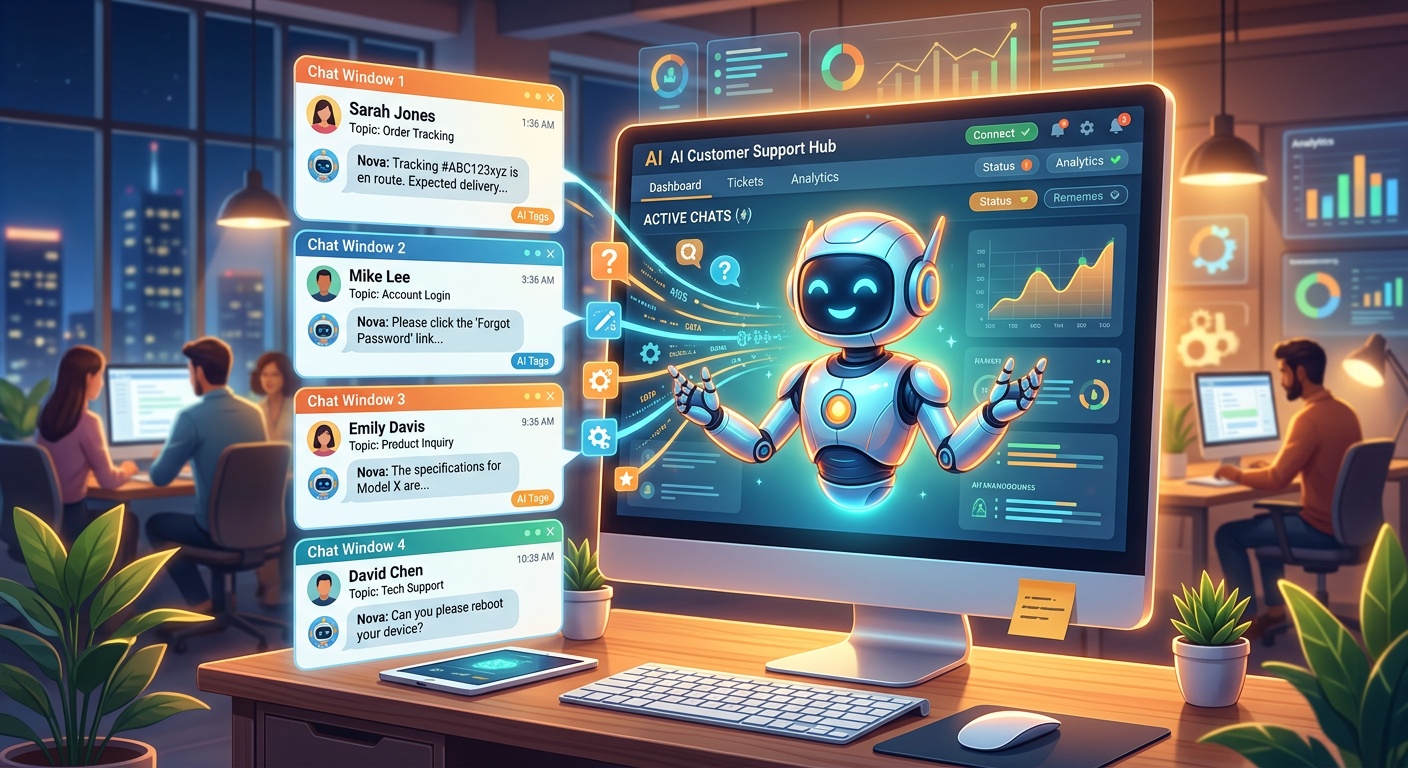
Salesforce’s Agentforce platform lets businesses deploy autonomous agents that qualify leads, update CRM records, draft emails, and schedule follow-ups.
Agentforce was handling over a million AI-created sales opportunities per week by early 2026, according to Salesforce’s earnings reports.
MIT’s Project NANDA study found that buying agent platforms from established vendors like Salesforce succeeded about 67% of the time—double the success rate of building custom agents from scratch.
Our guide on the best AI agents for business includes a detailed comparison of Agentforce against competitors.
3. Autonomous Research and Reporting Agents
Several platforms now offer autonomous agents that continuously monitor data sources, generate reports, and send alerts without human prompting.
These agents operate across finance (analyzing market trends), e-commerce (tracking inventory and competitor pricing), and marketing (monitoring campaign performance).
BCG found that only 5% of companies capture significant AI value, and the common thread among them is that they use autonomous agents for data collection and analysis while humans focus on strategic interpretation.
Our article on how to build AI agents covers the technical architecture behind these autonomous agents.
4. n8n Autonomous Workflow Agents
n8n is an open-source platform that lets users build autonomous agents that connect thousands of apps without coding.
More than 70% of n8n’s new users in 2026 are non-developers, according to company data.
The platform’s AI agent nodes can make decisions based on incoming data, trigger actions across connected services, and self-correct when errors occur.
5. Legacy Enterprise: Automated Approval Systems
One of the least glamorous but most effective use cases for autonomous AI agents is in purchasing and approval workflows.
Companies like Siemens and Unilever have deployed agents that automatically match purchase orders to invoices, flag discrepancies, and route exceptions to human approvers.
Our guide on AI agents for small business includes templates for building your own approval automation agent.
What These Examples Teach Us
Every successful autonomous AI agent shares three characteristics: a narrow scope (one specific task), a clear metric for success, and human-in-the-loop boundaries for exceptions.
The agentic AI market is projected to reach USD 93.2 billion by 2032 at a 44.6% CAGR.
PwC’s 2026 predictions found that 66% of businesses using AI agents report productivity gains.
The autonomous AI agents examples in this article represent the leading edge of what is possible today—and the data shows that businesses adopting them now are building a competitive gap that will only widen over the next five years.