When a single AI agent can handle one task well, you might wonder what happens when you connect several of them together to solve much bigger problems.
That is the promise of multi agent AI systems—where multiple specialized agents collaborate, communicate, and coordinate to complete complex workflows that no single agent could handle alone.
A multi-agent system is a group of intelligent agents that interact with each other to achieve goals that are beyond the capability of any individual agent.
LangChain’s 2025 State of AI Agents report found that 51% of organizations using agents had already deployed multi-agent architectures in production.
Gartner predicts that by 2027, 40% of agentic AI projects will be canceled, but among the survivors, multi-agent systems will dominate because they solve the most valuable business problems.
BCG found that the 5% of companies capturing significant AI value are disproportionately using multi-agent architectures rather than single-agent deployments.
The shift from single agents to multi agent AI systems represents the next evolution of business automation.
How Multi Agent AI Systems Work

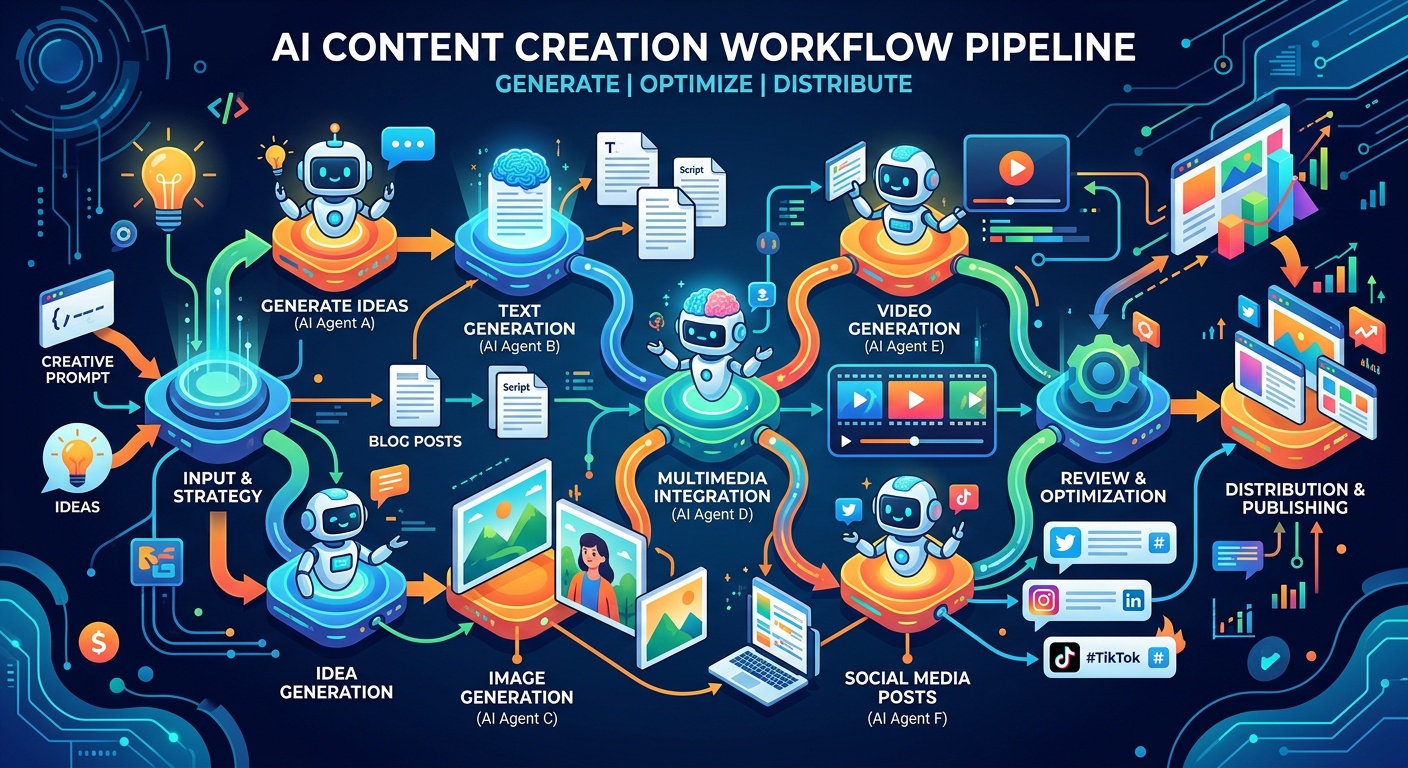
In a multi-agent architecture, each agent has a specific role with its own tools, knowledge base, and decision-making parameters.
One agent might be responsible for monitoring customer inquiries, another for looking up order information, another for processing refunds, and a supervisor agent that decides which agent handles each request.
The agents communicate through a shared message bus or orchestration layer, passing context and results between each other.
CrewAI and AutoGen are two of the most popular open-source frameworks for building multi agent AI systems in 2026.
Both allow developers to define agent roles, assign tools, and set up delegation rules with minimal code.
Building AI agents for multiple workflows becomes significantly more powerful when you connect them into a coordinated system.
Real-World Multi Agent Deployments
Enterprise customer support is the most common production use case for multi agent AI systems.
A triage agent identifies the issue type, a knowledge agent searches the knowledge base, a resolution agent applies the fix, and an escalation agent routes complex cases to human support.
Sales pipeline management is another strong use case: a prospecting agent finds leads, a research agent enriches data, a scoring agent prioritizes, and an outreach agent drafts messages.
Google Cloud’s ROI of AI Study found that organizations deploying multi-agent systems reported higher ROI than single-agent deployments, with 88% of early adopters reporting positive returns.
PwC’s 2026 survey showed that businesses using AI agents for complex workflows reported 66% productivity gains and 57% cost savings.
The Complexity Trap
Multi agent AI systems are more powerful than single agents, but they are also more complex to build and maintain.
MIT’s Project NANDA study found that 95% of agentic AI projects failed to deliver a return on investment.
The failure rate was highest among projects that tried to build multi-agent systems from scratch without using established frameworks.
Buying a proven multi-agent platform from a specialized vendor succeeded 67% of the time, while custom-built systems succeeded only 33% of the time.
Gartner’s estimate that 40% of agentic AI projects will be canceled by 2027 is a warning against over-engineering your agent architecture.
Small businesses using AI agents should start with single-agent deployments and only add multi-agent complexity when the single agent cannot handle the full workflow.
The Bottom Line on Multi Agent Systems
Multi agent AI systems are not hype—they are already deployed in production at companies using Salesforce Agentforce, n8n, and CrewAI.
But they are only as effective as their architecture allows them to be.
The companies seeing the best results follow a simple rule: start with one agent, prove the ROI, then add more agents one at a time.
Each new agent should handle a specific, measurable task.
When you connect five agents that each deliver a clear return, you get a multi-agent system that is worth more than the sum of its parts.
And that is exactly what the data from Google Cloud, PwC, and BCG is showing us.