The AI agent framework landscape in 2026 is nothing short of explosive. Every major lab — OpenAI, Anthropic, Google, Microsoft — has shipped its own agent SDK. Open-source projects are crossing six-figure GitHub stars at record speed. And the frameworks that dominated just a year ago look fundamentally different today.
If you’re trying to figure out which AI agent framework to build on, you’re not alone. The choice can feel overwhelming. That’s exactly why we put together this comparison — to help you cut through the noise and pick the right framework for your specific use case.
What Is an AI Agent Framework?
Before diving into the 12 frameworks, let’s get clear on what we’re talking about. An AI agent framework is a software toolkit that provides the building blocks for creating autonomous AI systems — programs that can reason, plan, use tools, maintain memory, and take actions to accomplish goals without continuous human intervention.
Instead of calling an LLM API and getting a single response, an agent framework manages the full loop: decide what to do next, act, observe the result, and decide again until the goal is achieved. It handles the plumbing — LLM calls, tool routing, state management, error handling — so you can focus on building the logic.
In 2026, a production-grade agent framework provides four core capabilities:
- Orchestration — how the control flow is defined (graphs, crews, handoffs, hierarchies)
- Memory and State — short-term working memory, long-term persistence, and durable checkpointing
- Tool Integration — standardized interfaces for APIs, databases, filesystems, and MCP servers
- Observability and Governance — tracing, evaluation, audit logging, human-in-the-loop gates
Quick Comparison: 12 Best AI Agent Frameworks at a Glance
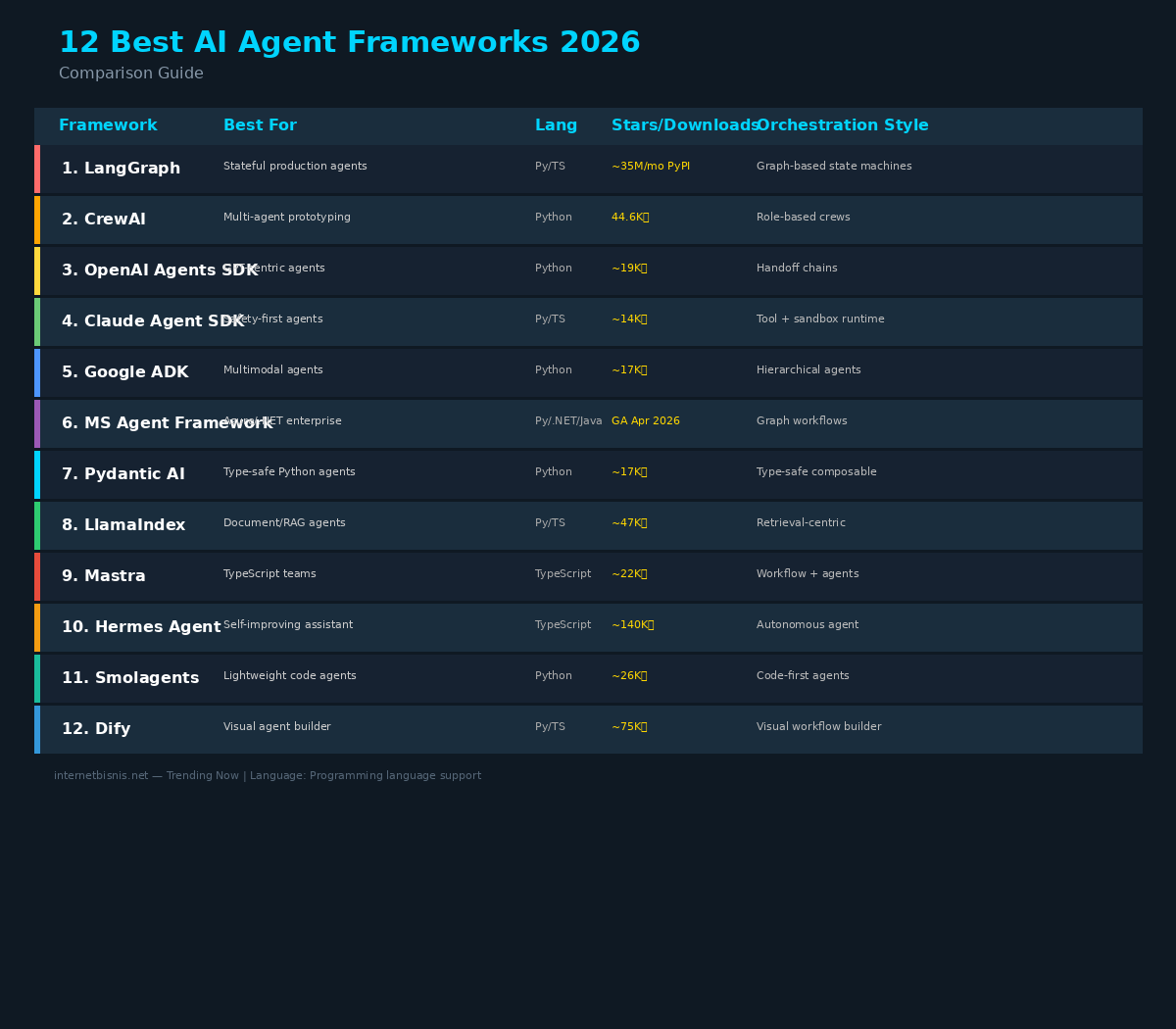
1. LangGraph — The Production Standard for Stateful AI Agents
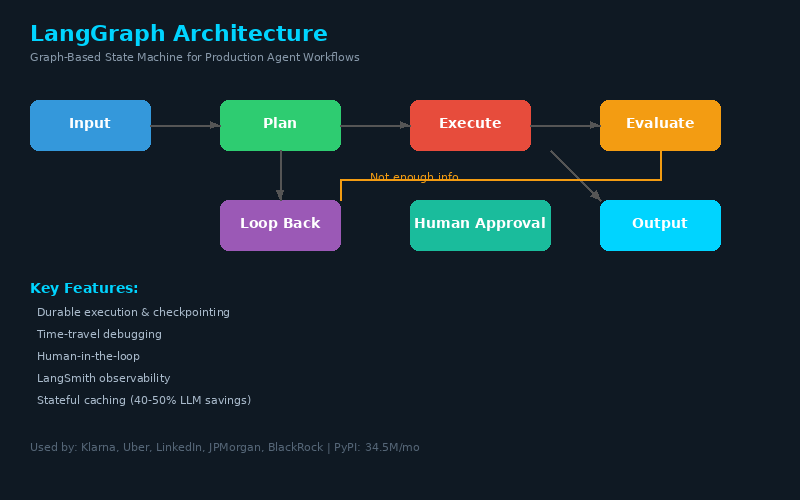
What it is: LangGraph, built by the LangChain team, models agent workflows as directed graphs where nodes are processing steps and edges define state transitions. It ships durable execution, checkpointing, time-travel debugging, and first-class human-in-the-loop primitives.
Production signal: Around 400 companies run LangGraph Platform deployments — Klarna, Uber, LinkedIn, Elastic, BlackRock, Cisco, Replit, and JPMorgan. Monthly PyPI downloads: 34.5 million.
Pros
- Maximum control over every step of the agent workflow
- Built-in checkpointing with time-travel debugging
- Human-in-the-loop patterns are first-class
- LangSmith integration for observability and tracing
- Stateful caching saves 40-50% LLM calls on repeat workflows
Cons
- Steep learning curve — budget 1-2 weeks before productive
- Over-engineered for simple linear agents
- API documentation changes frequently
Best For
Complex, multi-step agent workflows needing production reliability, audit trails, and durable state. Regulated industries.
2. CrewAI — Fastest Path to Multi-Agent Prototypes
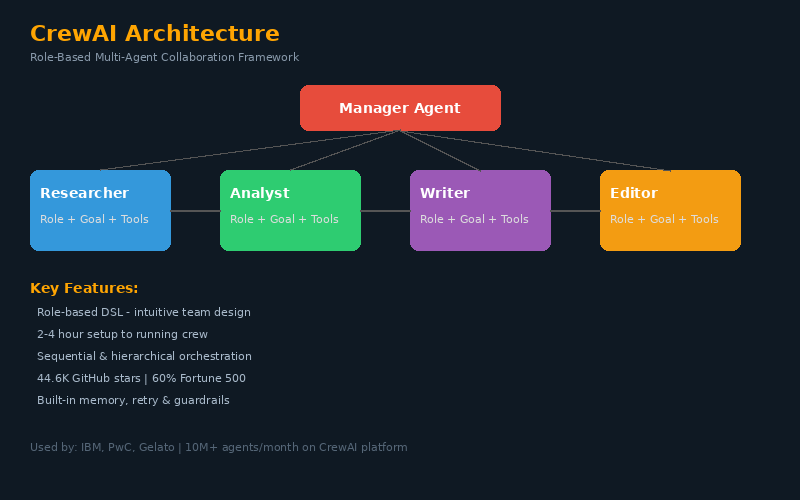
What it is: CrewAI organizes agents into “crews” — teams of role-based agents with goals, backstories, and task assignments. The abstraction maps naturally to how non-technical stakeholders think about work.
Production signal: 44,600+ GitHub stars, ~60% of Fortune 500 have explored it. Enterprise deployments at IBM, PwC, and Gelato. 10M+ agents executed per month.
Pros
- Intuitive role-based mental model
- 2-4 hour setup from install to running multi-agent system
- Built-in collaboration and delegation
- Good defaults for retry logic and memory management
Cons
- Up to 3x token overhead vs LangGraph
- Less control over agent communication
- Scaling limitations with complex branching
Best For
Fast prototyping of multi-agent systems, content creation, research pipelines, and any task decomposing cleanly into specialist roles.
3. OpenAI Agents SDK — Minimalist Power for GPT Ecosystems
What it is: The successor to OpenAI’s experimental Swarm SDK, built around five primitives: Agents, Handoffs, Guardrails, Sessions, and Tracing. The April 2026 overhaul added native sandbox execution, Codex-style filesystem tools, and MCP support.
Pros
- Minimalist design — five primitives, hours of onboarding
- Native sandboxing for shell execution
- Supports 100+ LLMs via Chat Completions API
- Voice agent support via Realtime API
- ~10.3 million monthly downloads
Cons
- Heavily optimized for OpenAI models
- Not flexible enough for complex branching
- Vendor lock-in risk
Best For
GPT-centric production deployments, voice agents, and teams wanting sandboxed tool use out of the box.
4. Claude Agent SDK (Anthropic) — Safety-First Agent Framework
What it is: Packages the same infrastructure powering Claude Code as Python and TypeScript libraries. Agents read and edit files, run shell commands, search the web, and call tools via MCP servers in a sandboxed environment.
Pros
- Battle-tested infrastructure (same loop as Claude Code)
- Constitutional AI safety constraints baked in
- Extended thinking for auditable reasoning
- Self-hosted sandboxes for data privacy
Cons
- Total model lock-in — works only with Claude
- Safety features only work with Claude models
Best For
Autonomous coding and research workflows where safety and auditability are non-negotiable.
5. Google ADK — Multimodal Agents for GCP Natives
What it is: Google’s open-source Agent Development Kit with native OpenAPI/MCP support and tight integration with Gemini and Vertex AI. Hierarchical architecture with parent agents orchestrating specialized sub-agents.
Pros
- Strongest multimodal support (video, voice, image, text)
- A2A protocol with 50+ partners
- Graph-based execution with routing and retry
- Massive integration ecosystem
Cons
- Best experience on Gemini/Vertex AI only
- Smaller community than LangGraph or CrewAI
Best For
GCP-native teams and multimodal workflows leveraging A2A interoperability.
6. Microsoft Agent Framework — The Azure Enterprise Standard
What it is: The consolidated successor to AutoGen and Semantic Kernel, reaching v1.0 GA in April 2026. Supports Python, .NET, and Java with graph-based workflow orchestration.
Pros
- Best choice for .NET teams and Azure-native enterprises
- Azure Cosmos DB and Application Insights integrated
- Responsible-AI primitives built in
Cons
- Outside Microsoft ecosystem, LangGraph is stronger
- Migration from AutoGen 0.2 requires real work
- Too new for long production track records
Best For
Enterprises on .NET or Azure needing first-class governance and compliance.
7. Pydantic AI — Type-Safe Python Agent Framework
What it is: Built by the team behind Pydantic Validation, it brings FastAPI’s ergonomic feel to agent development. Fully type-safe with validation that catches errors at write-time.
Pros
- Fully type-safe — errors surface at write-time
- Model agnostic across all major providers
- Native MCP, A2A, and durable execution
- Define agents in YAML/JSON with no code
Cons
- Fewer pre-built templates than LangChain
- Still maturing in large-scale production
Best For
Python teams using Pydantic/FastAPI wanting type-safe, well-structured agent code.
8. LlamaIndex — Document-Centric RAG Agents
What it is: Started as a data framework for LLMs and evolved into a full agent framework focused on document intelligence. The Workflows engine adds event-driven orchestration.
Pros
- 160+ data connectors for RAG workflows
- Advanced indexing: vector, tree, keyword, hybrid
- LlamaParse for complex document parsing
- Multi-source reasoning across docs, databases, and APIs
Cons
- Agent capabilities secondary to data framework roots
- Best used with a second orchestration layer
Best For
Document-heavy agents, RAG pipelines, and knowledge bases. Often paired with LangGraph.
9. Mastra — The TypeScript-First Agent Framework
What it is: Built by Gatsby.js founders, Mastra hit v1.0 in January 2026 with 22,000+ GitHub stars and 300,000+ weekly npm downloads. A full-stack agent toolkit in TypeScript.
Pros
- TypeScript-native from the ground up
- Unified model router — 3,300+ models from 94 providers
- Mastra Cloud for managed deployments
- $13M funding from Y Combinator
Cons
- Python-first teams should look elsewhere
- Younger ecosystem still growing
Best For
TypeScript teams wanting a modern framework with built-in cloud deployment.
10. Hermes Agent — The Self-Improving Autonomous Agent
What it is: Built by Nous Research, Hermes crossed 140,000 GitHub stars in under 3 months. Its defining feature: a closed learning loop that writes reusable “skills” after completing tasks.
Pros
- 40+ built-in tools (files, web, code, APIs)
- Self-improving — more capable the more you use it
- Fully self-hosted, runs 24/7
- Multi-gateway: CLI, Telegram, Discord, Slack, WhatsApp, Signal
Cons
- Autonomous agent, not a framework for building products
- Breaking changes common with rapid iteration
Best For
Power users wanting a self-hosted, self-improving personal AI assistant.
11. Smolagents — HuggingFace’s Minimalist Code Agents
What it is: HuggingFace’s radically simple framework — ~1,000 lines of core code. Agents write and execute Python code directly instead of generating JSON, reducing LLM calls by ~30%.
Pros
- ~1,000 lines of core code — fully auditable
- Code-first reduces LLM calls by ~30%
- Multi-modal (vision, video, audio)
- Model agnostic via LiteLLM
Cons
- No built-in state management or orchestration
- More DIY — not batteries-included
Best For
Researchers wanting lightweight, transparent code-first agents.
12. Dify — Open-Source Visual Agent Builder
What it is: With 75,000+ GitHub stars, Dify sits at the intersection of visual development and code-first flexibility. Design agent workflows visually, add RAG pipelines, connect tools, and deploy.
Pros
- Visual workflow builder — no code needed
- Built-in RAG engine
- Self-hosted with full data control
- Plugin ecosystem
Cons
- Application platform, not a pure framework
- Infrastructure maintenance is on you
Best For
Teams wanting visual agent development with self-hosting for internal tools.
How to Choose the Right AI Agent Framework
Here’s a practical decision guide based on your specific situation:
- Regulated industry + audit trails — LangGraph
- Fast multi-agent prototype — CrewAI
- .NET or Azure-native stack — Microsoft Agent Framework
- GPT-centric sandboxed use — OpenAI Agents SDK
- Multimodal + GCP-native — Google ADK
- Type-safe Python agent — Pydantic AI
- RAG-heavy knowledge agent — LlamaIndex
- TypeScript / Next.js team — Mastra
- Self-hosted personal assistant — Hermes Agent
- Lightweight code-first agents — Smolagents
- Visual no-code builder — Dify
Important Trends Shaping AI Agent Frameworks in 2026
Three structural shifts are redrawing the framework map:
1. The Protocol Layer Went Open. MCP and A2A moved from proprietary specs to Linux Foundation stewardship. Every major framework now supports MCP, collapsing switching costs.
2. Vendor SDKs Matured. Every frontier lab now ships a production-intent agent SDK optimized for its own models.
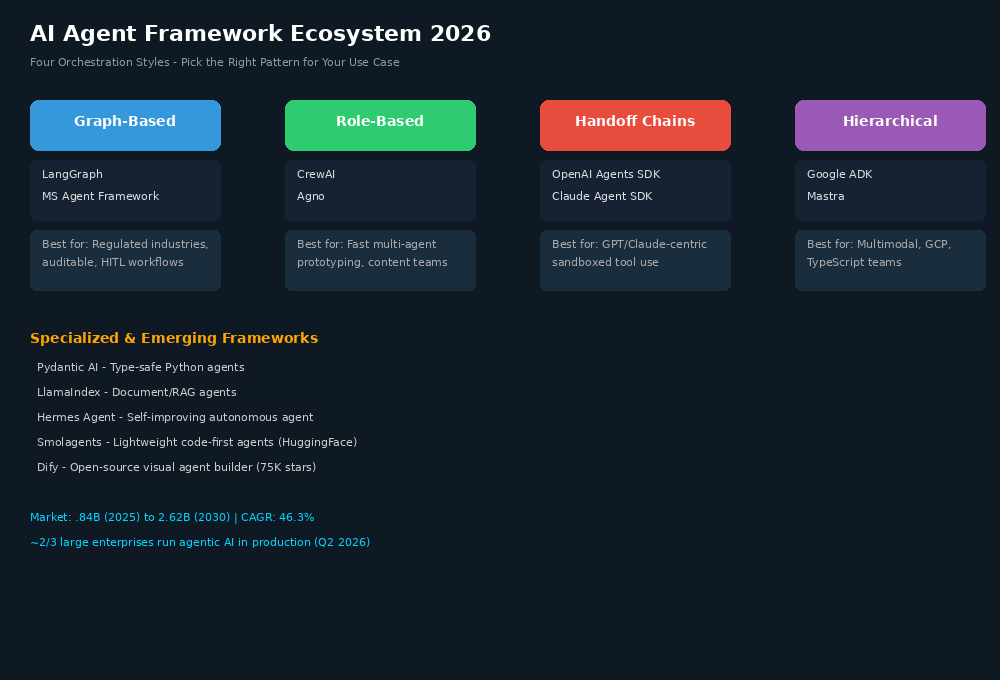
3. Production Patterns Stabilized. Four styles emerged: Graph-based (LangGraph, MS), Role-based (CrewAI), Handoff-based (OpenAI SDK), and Hierarchical (Google ADK).
The Bottom Line
The agentic AI market is projected to grow from $7.84B in 2025 to $52.62B by 2030. The frameworks have split into clear lanes: production orchestration (LangGraph, MS), prototyping (CrewAI, Dify), vendor SDKs (OpenAI, Claude, Google), developer-first (Mastra, Pydantic), specialized (LlamaIndex, Smolagents), and autonomous (Hermes).
Watch: AI Agent Frameworks in Action
Ready to learn more? Check out our other guides on AI Tools and Artificial Intelligence for more in-depth coverage.
