What Is LangGraph?
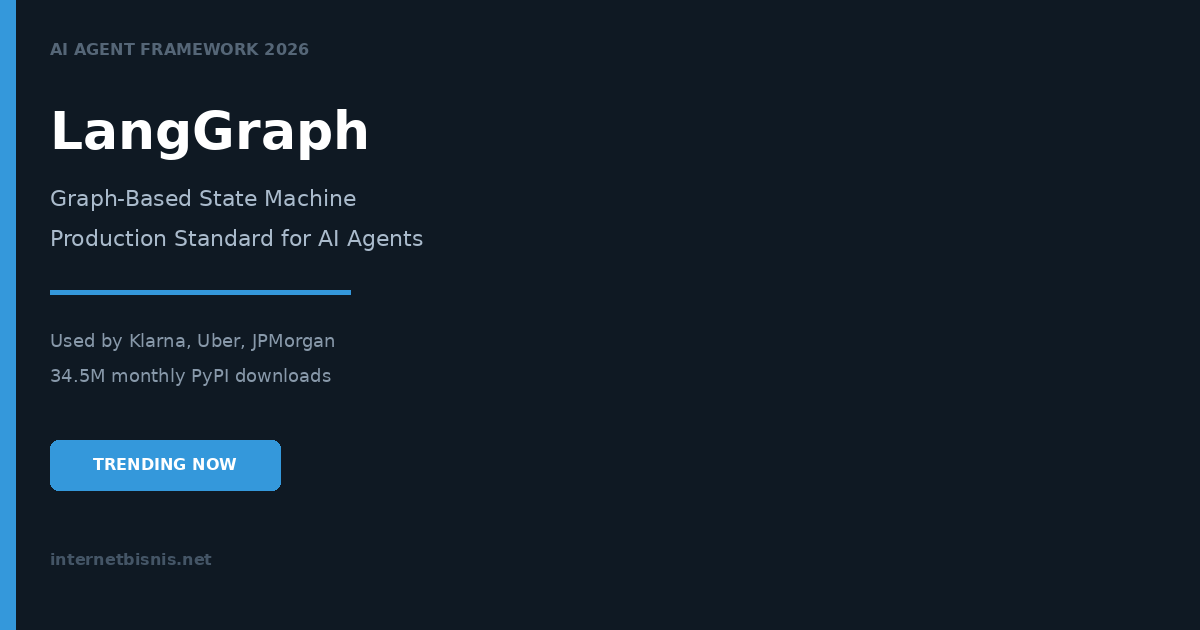
LangGraph is a low-level orchestration framework built by the LangChain team that models AI agents as directed graphs — where nodes are processing steps and edges define state transitions. Unlike simpler frameworks that abstract away the control flow, LangGraph gives you explicit control over every decision point in your agent workflow. It ships with durable execution, automatic checkpointing, time-travel debugging, and first-class human-in-the-loop primitives. In 2026, LangGraph is the consensus choice for production-grade AI agent deployments, especially in regulated industries where audit trails and deterministic control are non-negotiable.
LangGraph Architecture Overview
LangGraph models agent workflows as state machines. Your define nodes (functions that process state), edges (transitions between nodes), and a typed state schema that flows through the graph. This is fundamentally different from simpler chain-based approaches because it handles cycles naturally: an agent that needs to retry, gather more info, or loop through a planning process is just a graph with cycles. The framework provides built-in checkpointers (in-memory, SQLite, Postgres) that save state at every step, enabling time-travel debugging, rollback, and process recovery.
Key Features of LangGraph
- Explicit graph-based state machine control
- Built-in checkpointing with Postgres/SQLite persistence
- Time-travel debugging — replay any step of any agent run
- First-class human-in-the-loop approval primitives
- LangSmith integration for production observability
- Stateful caching that saves 40-50% on repeat workflows
- MCP-native tool calling support
- Graph visualization for audit trail compliance
Pros of LangGraph
- Maximum control over every step of the agent workflow — no magic, no hidden prompts
- Production-ready checkpointing, streaming, and human-in-the-loop support
- LangSmith integration for debugging and monitoring at scale
- Stateful caching saves 40-50% on repeated LLM calls
- Graph architecture maps cleanly to audit trails for compliance
- Handles cycles, retries, and error recovery as first-class concepts
- 400+ verified enterprise deployments including Klarna, Uber, JPMorgan
- 34.5M monthly PyPI downloads — the largest ecosystem
Cons of LangGraph
- Steepest learning curve of any framework — budget 1-2 weeks to productivity
- Over-engineered for simple linear agents with a few tools
- Verbose boilerplate for straightforward “call LLM, use tool” patterns
- Documentation and API change frequently — tutorials expire quickly
- Graph thinking is not intuitive for developers used to imperative code
Best Use Cases for LangGraph
LangGraph is the right choice when you need maximum control and reliability. Use it for: regulated financial services workflows requiring complete audit trails; long-running autonomous agents that must survive server restarts; complex multi-step reasoning systems with conditional branching; any production deployment where the cost of a wrong agent decision exceeds the onboarding cost. It’s the default framework for enterprise agent deployments in banking, healthcare, insurance, and legal tech in 2026.
LangGraph vs Alternatives in 2026
vs CrewAI: LangGraph offers more control and better token efficiency but takes longer to learn. CrewAI is faster to prototype but hits scaling limits. vs OpenAI Agents SDK: LangGraph is model-agnostic and offers explicit state management; the SDK is simpler but locks you into OpenAI’s ecosystem. vs Pydantic AI: LangGraph has more enterprise deployments and a larger ecosystem; Pydantic AI offers better type safety and FastAPI-style development.
LangGraph Adoption and Community in 2026
LangGraph has the strongest enterprise adoption of any AI agent framework in 2026. Approximately 400 companies run LangGraph Platform deployments in production, including Klarna, Uber, LinkedIn, Elastic, BlackRock, Cisco, Replit, and JPMorgan. Klarna’s customer-support agent — publicly reported to handle roughly two-thirds of the company’s customer inquiries — runs on LangGraph. The framework achieves 34.5 million monthly PyPI downloads and reached v1.0 GA in October 2025.
Getting Started with LangGraph
To get started with LangGraph: install via pip install langgraph, define your state schema using TypedDict, create nodes as functions, build your graph with conditional edges, compile it, and invoke with inputs. The official documentation at langchain-ai.github.io/langgraph provides excellent tutorials. Start with a simple ReAct agent before building complex multi-agent workflows. Use LangSmith for tracing from day one — it will save hours of debugging later.
Conclusion: Is LangGraph Right for You?
LangGraph is the right choice if you’re building production agent systems where reliability, auditability, and deterministic control matter more than speed-to-demo. The learning investment is real — budget 1-2 weeks before your team is productive — but for complex, stateful workflows, no other framework offers the same level of control and production readiness. If your use case is simple, consider a lighter framework. If your use case is complex, LangGraph is worth the learning curve.
Learn More About LangGraph
Explore more AI agent frameworks:
- CrewAI Guide
- OpenAI Agents SDK Guide
- Claude Agent SDK Guide
- Google ADK Guide
- Microsoft Agent Framework Guide
- Pydantic AI Guide
- LlamaIndex Guide
- Mastra Guide
- Hermes Agent Guide
- Smolagents Guide
- Dify Guide
Also check out our AI Tools and Artificial Intelligence categories for more in-depth coverage.