You keep hearing that AI agents are the future of business automation, but every tutorial you find assumes you already know Python, APIs, and prompt engineering — and you are starting to wonder if learning how to build AI agents is even realistic without a computer science degree.
Here is the short answer: yes, it is.
Here is the longer answer: the tools have changed so dramatically in the past 18 months that what used to require a development team can now be done by someone who has never written a line of code.
What Most People Get Wrong About Building AI Agents
Gartner estimates that of the thousands of companies marketing agentic AI, only about 130 are real — the rest are rebranding existing chatbots as agents.
This means when you search for how to build AI agents, half the advice you find is about building things that are not actually agents.
A real AI agent does not just respond to prompts.
It observes its environment, makes decisions, takes action, evaluates the result, and iterates — all without a human standing by to push the button.
The LangChain State of AI Agents report (2024 edition, surveying more than 1,300 professionals) found that 51% of companies were already using AI agents in production that year.
By 2026, Gartner predicts that 40% of enterprise applications will include task-specific agents.
The window for getting in early is closing, but the tools for doing so have never been more accessible.
The Old Way vs. The New Way of Building Agents

The old way required you to understand LangChain, vector databases, embedding models, tool-calling protocols, and at least one programming language.
The new way lets you describe what you want in plain English and get a working agent in minutes.
Platforms like n8n, Make, Zapier, Gumloop, and Lindy now offer no-code or low-code interfaces where you build agents by connecting visual blocks.
You tell the agent what tool to use, what data source to read, and what action to take when it finds a match.
The AI handles the reasoning layer itself.
This is not a simplified version of the real thing.
It is the real thing with a better interface.
Three Methods to Build Your First AI Agent
Method 1: No-Code Visual Builders (Zero Technical Skill Required)
n8n is an open-source workflow platform that now includes native AI agent nodes.
You drag an AI agent block onto a canvas, connect it to a data source like Google Sheets or your CRM, give it a goal in natural language like “summarize every new lead and post a Slack message,” and it runs.
According to the 2026 n8n ecosystem survey, over 70% of n8n’s new users this year are non-developers building AI agents for their teams.
Make (formerly Integromat) and Zapier offer similar capabilities with more templates for common small business use cases.
The average setup time for a basic agent on these platforms is under 30 minutes.
For a small business, this means you can have an AI agent qualifying leads or answering customer FAQs by lunchtime.
If you are still wondering whether AI agents for business are worth the investment, our latest breakdown on AI agents for small business ROI covers the specific metrics to track.
Method 2: Agentic AI Frameworks (Some Willingness to Learn)
If you are comfortable with basic concepts like APIs and JSON but do not want to write full code, platforms like Dify, Flowise, and Relevance AI offer visual agent builders with more flexibility.
These tools let you connect multiple AI models, build conditional logic, and chain agents together into multi-step workflows.
Many businesses that started with no-code agents eventually move to this tier when they need more customization.
For example, companies using AI agents to automate repetitive tasks often start with Zapier templates and graduate to n8n or Dify as their agent complexity grows.
Method 3: Code-Based Agent Building (Maximum Control)
If you do know how to code, or have access to a developer, frameworks like LangChain, CrewAI, AutoGen, and Semantic Kernel give you full control over agent behavior.
These are the tools that power the enterprise-grade agents you read about in case studies.
But here is the important part: most small businesses do not need this level of control to get value.
The PwC 2026 AI Business Predictions report notes that companies using agents cited 66% productivity gains — and most of those gains came from straightforward agents built on no-code platforms, not custom-built frameworks.
What You Actually Need to Know
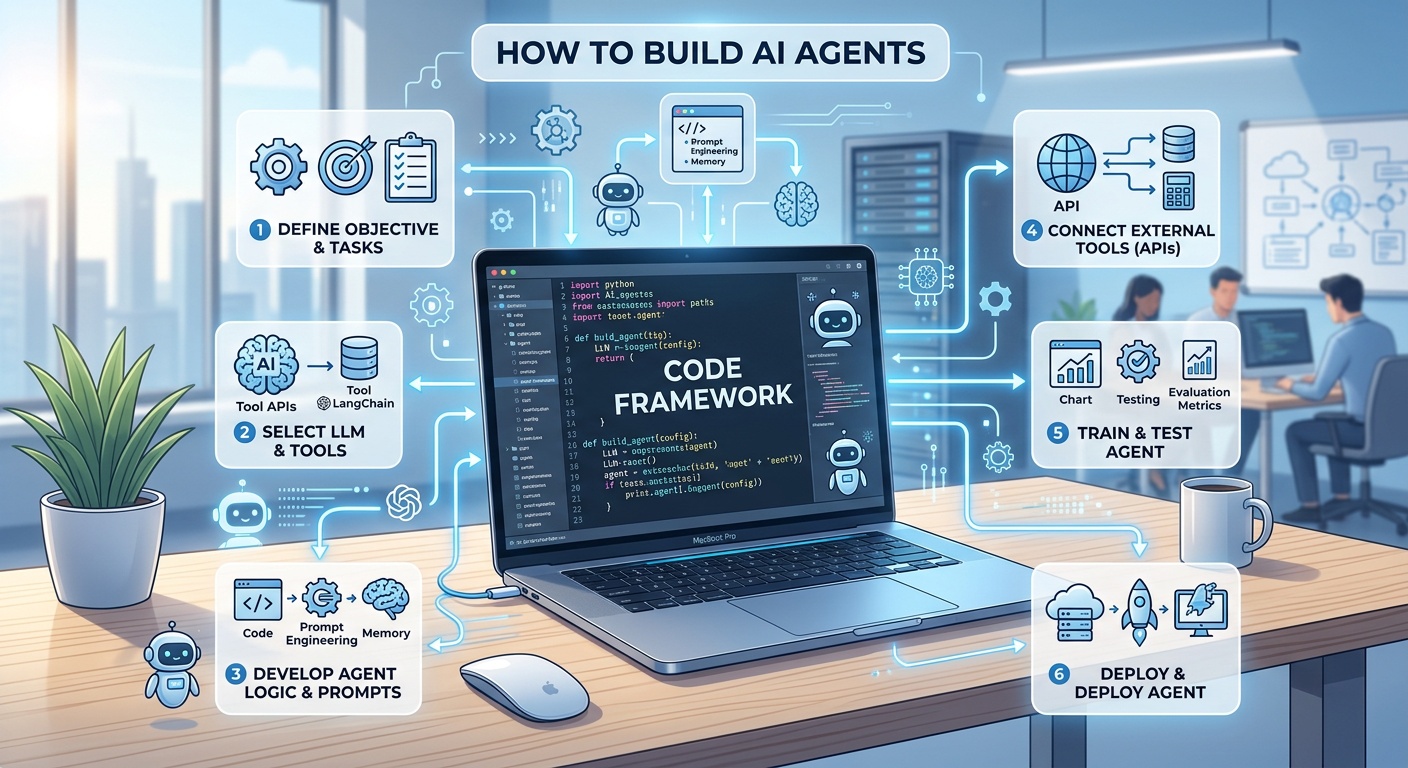
Learning how to build AI agents boils down to understanding four concepts, none of which require coding:
Triggers. What event starts the agent? A new email? A form submission? A scheduled time?
Data sources. What information does the agent need to do its job? A CRM, a spreadsheet, a website?
Actions. What should the agent do with the information? Send an email, update a record, post a message?
Feedback loops. How does the agent know if it succeeded? Does it need human approval before acting?
Once you grasp these four elements, you can build an AI agent for almost any business process.
Existing articles on how to build AI agents for customer support automation demonstrate these principles using real business workflows.
The Tools Landscape in 2026
The agent-building ecosystem has consolidated into three tiers.
Tier one is no-code: n8n, Make, Zapier, Gumloop, Lindy.
Tier two is low-code: Dify, Flowise, Relevance AI, MindStudio.
Tier three is full-code: LangChain, CrewAI, AutoGen, Semantic Kernel, Google ADK.
Most small businesses get everything they need from tier one.
Most mid-market teams add tier two for specific use cases.
Only enterprises with compliance requirements or custom infrastructure typically need tier three.
Microsoft Copilot Studio and Salesforce Agentforce represent a fourth category: platform-native agents that work inside existing ecosystems, but they are tied to Microsoft and Salesforce respectively and do not offer the flexibility of open tools.
The Hardest Part Is Not the Building
BCG’s Widening AI Value Gap report found that only 5% of companies are capturing significant value from AI at scale.
But here is what the report does not say: the 5% that succeeded did not build better agents.
They chose better problems to solve.
The businesses that fail with AI agents fail because they deploy them in the wrong use case — not because the agent technology was flawed.
Gartner’s Anushree Verma described most canceled agent projects as “early stage experiments or proof of concepts that are mostly driven by hype and are often misapplied.”
The single most important skill in learning how to build AI agents is not technical.
It is the ability to identify which repetitive, high-volume task in your business is worth automating first.
Watch: AI Agents, Clearly Explained
This video by Jeff Su breaks down the difference between basic AI chatbots, workflows, and full AI agents in a way that makes the whole concept click:
The Timeline: From Zero to Your First Agent
Here is a realistic timeline based on hundreds of deployment case studies compiled across platforms like n8n, Make, and Gumloop:
Day 1: Pick one repetitive task in your business that consumes at least five hours per week. Set up a free account on n8n or Make.
Day 2: Follow a template tutorial. The n8n AI Agent template library has over 300 pre-built workflows. Do not build from scratch on your first attempt.
Day 3–4: Modify the template to use your actual data. Connect your CRM, your email, your calendar. Test with real inputs.
Day 5: Deploy in a limited capacity. Let the agent work on 10% of your traffic while you monitor its decisions.
Day 7: Review results, correct mistakes, and expand to 100% if the accuracy meets your threshold.
Google Cloud’s ROI of AI Study found that 74% of executives report a return on their generative AI investment within the first year, and 88% among early adopters of agentic AI.
For a small business, that timeline can shrink to weeks when the use case is narrow and the tool is already built for you.
The Verdict: Should You Learn How to Build AI Agents?
The agentic AI market is projected to grow from USD 7.06 billion in 2025 to USD 93.2 billion by 2032, at a 44.6% compound annual growth rate.
That is not a trend you can afford to watch from the sidelines.
The tools are free or cheap. The learning curve has been flattened by no-code platforms. The data proving ROI is publicly available from Google Cloud, PwC, and BCG.
The only missing piece is your willingness to start.
And the best part?
Your first agent does not need to be perfect.
It just needs to save you one hour a week.
After that, you will wonder why you waited so long to learn how to build AI agents in the first place.