You have probably seen the same listicles claiming certain AI agents are the best for business, but when you dig into the actual deployment data from Google Cloud, Gartner, and BCG, a very different picture emerges about which agents actually deliver measurable returns.
An AI agent, at its core, is an autonomous software system that observes its environment, makes decisions, and takes action to achieve specific goals.
The difference between a good agent and a bad one is not the technology under the hood.
It is whether the agent was designed for a specific, high-volume business problem or just repackaged from an existing chatbot.
Gartner estimates that only about 130 companies out of thousands marketing agentic AI are actually selling genuine agents.
Everything else is what Gartner calls “agent washing” — rebranded chatbots dressed up as autonomous agents.
What the Data Consistently Shows
The Google Cloud ROI of AI Study (September 2025, surveying 3,466 senior leaders across 24 countries) found that 52% of executives say their organization is actively using AI agents, and 39% have deployed more than ten.
But the more important number is this: among early adopters of agentic AI — those who deployed agents for at least one specific, measured use case — 88% reported a positive return on investment.
PwC’s 2026 AI Business Predictions found that companies using agents reported 66% productivity gains and 57% cost savings.
BCG’s Widening AI Value Gap report tells the other side: only 5% of companies are capturing significant value from AI at scale, while roughly 60% capture no material value at all.
The best AI agents for business are not the ones with the most features.
They are the ones deployed in the right use case, measured against a single clear metric, and bought from a vendor that actually builds agents — not one that rebranded a chatbot.
The Tier List of Genuine AI Agents for Business
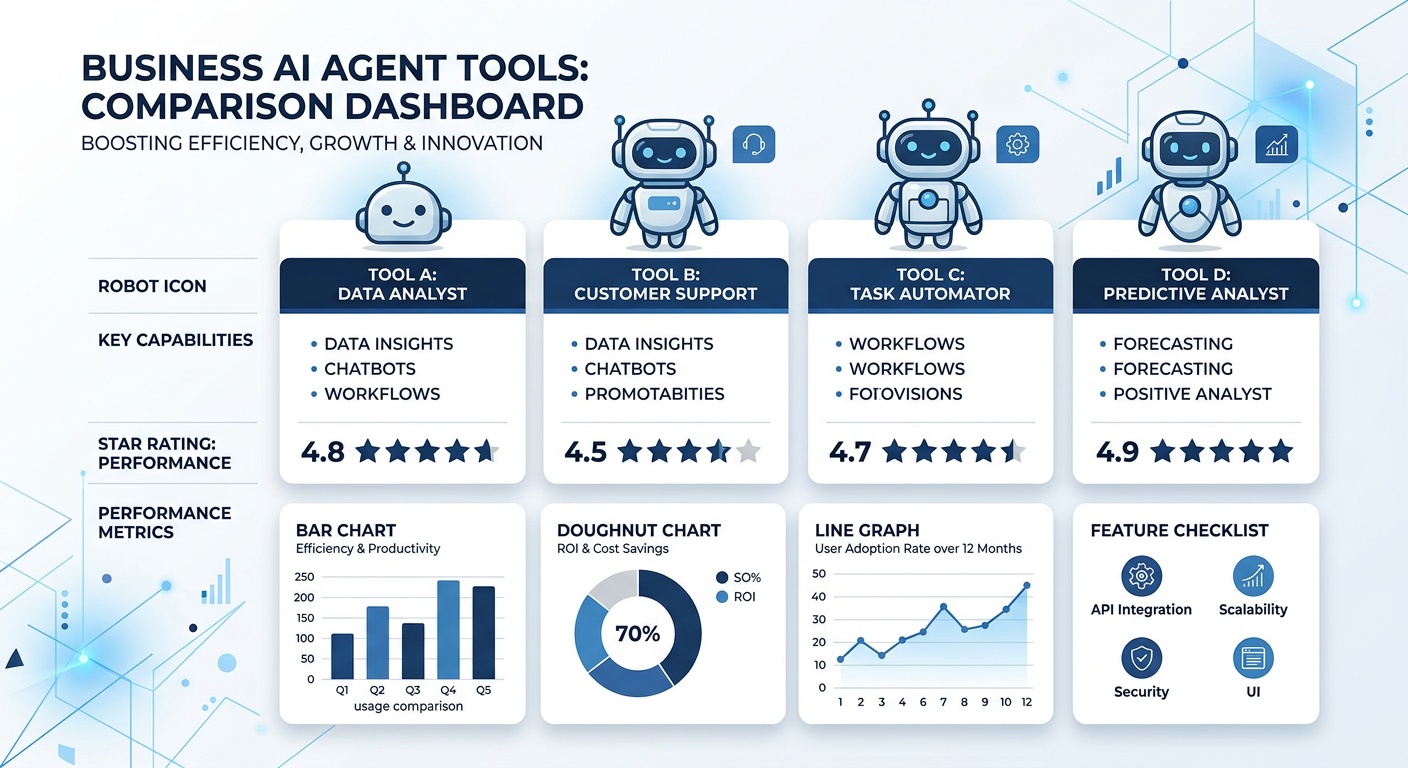
Based on verified deployment case studies, independent testing, and enterprise adoption data, here are the categories of AI agents that actually deliver for business in 2026.
Customer Service Agents
This is the most proven category.
Gartner predicts that by 2029, agentic AI will autonomously resolve 80% of common customer service issues without human intervention, cutting operational costs by 30%.
Klarna’s AI assistant handled 2.3 million conversations in its first month, doing the work of 700 full-time agents and reducing resolution time from 11 minutes to under 2 minutes.
The durable lesson from Klarna’s journey is that the best AI agents for business are those that handle Tier 1 inquiries and escalate complex issues to humans, not those that try to replace humans entirely.
If you are evaluating agents for customer support, our guide on how to build AI agents for customer support automation covers the specific platforms that work for this use case.
Sales and Lead Generation Agents
Salesforce’s 2024 research found that salespeople spend 71% of their time on non-selling tasks.
AI agents that handle lead qualification, CRM updates, and follow-up scheduling reclaim that time.
Among teams already using AI, 83% of sales teams with AI saw revenue growth in the past year, compared to 66% of teams without AI.
Tools like Lindy, Zapier Central, and n8n AI agents are the most commonly deployed in this category for small to mid-size businesses.
Enterprise teams typically use Salesforce Agentforce or Microsoft Copilot Studio for deeper CRM integration.
Operations and Workflow Automation Agents
Digital workflow automation saves employees up to 20 hours per week, according to a 2025 analysis of deployment outcomes.
Agents in this category handle invoice processing, inventory management, data entry, and cross-system orchestration.
n8n, Make, and Gumloop dominate the mid-market space, while UiPath and Workato serve enterprise clients with legacy system integrations.
Our article on how companies use AI agents to automate repetitive tasks provides real examples of these deployments.
How to Spot the Real Agents From the Washed Ones
Gartner’s estimate that only 130 companies sell genuine agents means most of what you find in a Google search is not what it claims to be.
Here are three tests to separate real agents from agent-washed products:
Test 1: Does it act autonomously? A real agent does not need a human to approve every step. It observes, decides, acts, and learns.
Test 2: Does it use external tools? A real agent connects to APIs, databases, and software. A chatbot only responds to text.
Test 3: Does it iterate based on results? A real agent evaluates its own output and adjusts. A static tool produces the same result regardless of context.
If a vendor cannot clearly explain how their agent passes these three tests, it is probably not a genuine agent.
The Platforms Worth Your Attention in 2026
The agent platform landscape has consolidated into clear categories based on business size and technical capability.
For small businesses with no technical team: Lindy, Zapier Central, and Gumloop. These platforms offer the fastest time-to-value with pre-built agent templates for common business processes. The average setup time is under one hour, and the cost ranges from free to USD 500 per month depending on volume.
For growing teams with some technical ability: n8n, Make, and Dify. These platforms offer visual builders with more flexibility. A typical deployment takes one to three days and costs USD 0 to USD 200 per month for self-hosted n8n or USD 50 to USD 1,000 per month for enterprise plans.
For enterprises with dedicated automation teams: Microsoft Copilot Studio, Salesforce Agentforce, UiPath, and Workato. These are the most expensive and most capable options. Implementation timelines range from weeks to months, and costs start at thousands of dollars per month.
MIT’s Project NANDA report found that buying AI tools from specialized vendors succeeded about 67% of the time, while internally-built tools succeeded only about one-third as often.
The takeaway is clear: buy the best AI agents for business from vendors who specialize in one category, not from generalists who claim to do everything.
The Metrics That Actually Matter
Most agent evaluations focus on features.
The data says you should focus on outcomes.
Here are the metrics that separate the 5% of companies that capture value from the 60% that do not, according to BCG’s research:
Time saved per week. The average successful deployment saves 15 to 20 hours per week per process. If your agent does not hit this within 30 days, the use case is wrong.
Cost per resolved issue. AI customer service agents reduce cost per ticket by 30% or more. If you are not seeing this, the agent is not routing effectively.
Accuracy rate. Production agents should hit at least 85% accuracy on their primary task within two weeks of deployment. Below that threshold, human oversight is still required.
User adoption. If the people who should use the agent are not using it, the agent failed — not the users.
Watch: Best AI Agent Tools in 2026 (Beginner Friendly)
Mikey No Code reviews the top AI agent platforms side by side, showing exactly what each tool can do and where it falls short:
The Verdict: Which AI Agents Should You Actually Buy?
The agentic AI market is projected to grow from USD 7.06 billion in 2025 to USD 93.2 billion by 2032 at a 44.6% compound annual growth rate, according to MarketsandMarkets.
The best AI agents for business in 2026 are not the ones with the most funding or the flashiest demos.
They are the ones that pass the three tests above, deliver a single metric you can measure in 30 days, and come from a vendor that builds genuine agents — not one that renamed its chatbot last quarter.
Start with customer service or lead generation agents from Lindy, n8n, or Zapier Central.
Measure time saved.
If the ROI is positive in 30 days, expand.
If it is not, the platform was not the problem.
The use case was.
For a broader perspective, our analysis on AI agents for small business ROI covers exactly which deployment patterns produced the strongest returns across hundreds of case studies.