What Is OpenAI Agents SDK?
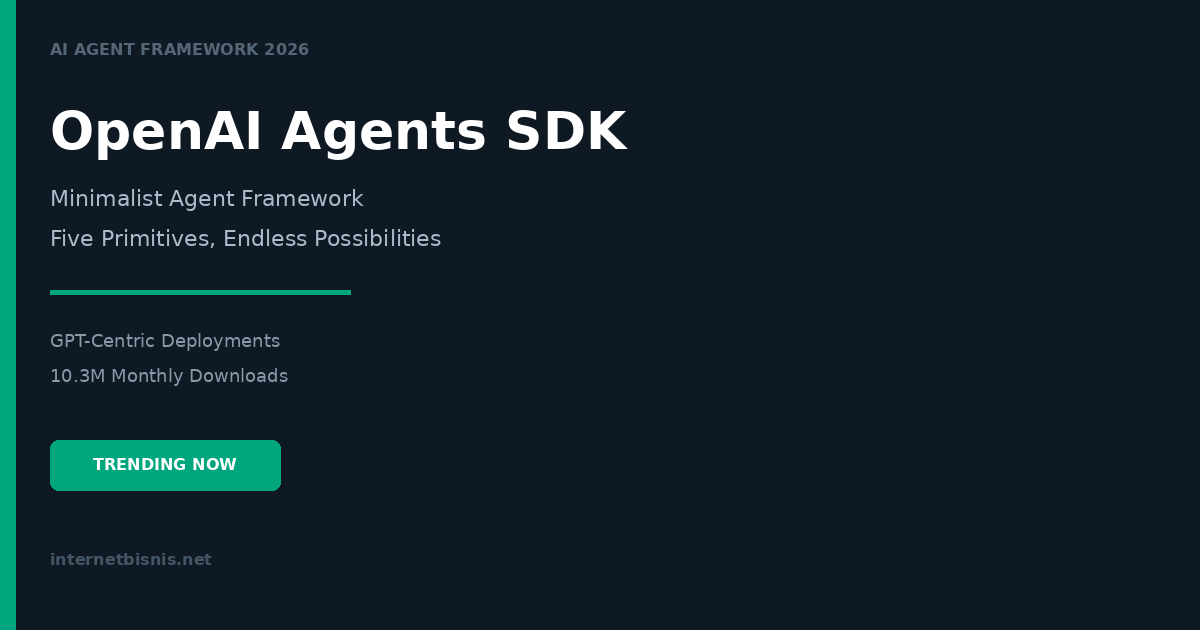
The OpenAI Agents SDK is the production-ready successor to OpenAI’s experimental Swarm project, built around five core primitives: Agents, Handoffs, Guardrails, Sessions, and Tracing. The April 2026 overhaul transformed it into a serious production framework with native sandbox execution, sub-agent orchestration patterns, Codex-style filesystem tools, and first-class Model Context Protocol (MCP) support. Despite the name, it supports 100+ LLMs through the Chat Completions API.
OpenAI Agents SDK Architecture Overview
The SDK is built around five primitives: Agents encapsulate instructions, tools, and model configuration; Handoffs transfer control between agents; Guardrails validate input and output at every step; Sessions maintain state across multiple turns; and Tracing provides built-in observability. The April 2026 overhaul added native sandbox execution environments that wrap agents in isolated containers with filesystem and shell access — removing the need to wire in third-party solutions.
Key Features of OpenAI Agents SDK
- Five minimal primitives — Agents, Handoffs, Guardrails, Sessions, Tracing
- Native sandbox execution with E2B, Modal, Cloudflare, Vercel
- Sub-agent orchestration in isolated sandboxes
- Support for 100+ LLMs through Chat Completions API
- Voice agent support via Realtime API integration
- Durable execution with snapshotting and rehydration
- MCP-native architecture
- ~10.3 million monthly downloads
Pros of OpenAI Agents SDK
- Minimalist design — five primitives, hours of onboarding, not days
- Native sandboxing removes need for third-party containers
- Supports 100+ LLMs despite the OpenAI name
- Voice agent support via Realtime API
- Durable execution with automated recovery
- 10.3M monthly downloads and growing rapidly
Cons of OpenAI Agents SDK
- Heavily optimized for OpenAI models — ergonomics favor GPT
- Not designed for complex branching and explicit state management
- TypeScript support still catching up to Python
- Vendor lock-in risk at the SDK layer
- Less flexible than graph-based frameworks for custom control flows
Best Use Cases for OpenAI Agents SDK
The OpenAI Agents SDK is best when you are already invested in OpenAI’s ecosystem and need sandboxed tool use out of the box. Use it for: GPT-centric production deployments; voice-based agents using the Realtime API; customer service chatbots with advanced tool use; coding assistants and developer tools; and any scenario where minimal setup time and built-in security matter more than framework flexibility.
OpenAI Agents SDK vs Alternatives in 2026
vs LangGraph: The SDK is simpler to set up (hours vs days) but LangGraph offers more control and works with any model. vs Claude Agent SDK: Both are vendor SDKs. Choose based on which model family you prefer — GPT or Claude. vs Google ADK: The SDK is optimized for GPT models; ADK is best for Gemini and multimodal workflows.
OpenAI Agents SDK Adoption and Community in 2026
The OpenAI Agents SDK has garnered ~19,000 GitHub stars and ~10.3 million monthly downloads. Despite the name suggesting OpenAI lock-in, the SDK supports 100+ LLMs through the Chat Completions API. The TypeScript SDK reached parity with Python in 2026. The April 2026 overhaul is widely considered the moment the SDK became a serious production option.
Getting Started with OpenAI Agents SDK
Install via pip install openai-agents. Create an Agent with instructions and tools, define handoffs to sub-agents, add guardrails for input/output validation, and run with the Runner class. The SDK is designed to be intuitive — most developers can build their first functional agent within an hour of reading the documentation at openai.github.io/openai-agents-python.
Conclusion: Is OpenAI Agents SDK Right for You?
The OpenAI Agents SDK is the right choice if you’re already invested in OpenAI’s ecosystem and want a minimal, elegant framework that gets out of your way. The sandboxed tool execution, voice support, and durable sessions make it compelling for production deployments. If you need model-agnostic flexibility or complex branching logic, consider LangGraph or Pydantic AI instead.
Learn More About OpenAI Agents SDK
Explore more AI agent frameworks:
- LangGraph Guide
- CrewAI Guide
- Claude Agent SDK Guide
- Google ADK Guide
- Microsoft Agent Framework Guide
- Pydantic AI Guide
- LlamaIndex Guide
- Mastra Guide
- Hermes Agent Guide
- Smolagents Guide
- Dify Guide
Also check out our AI Tools and Artificial Intelligence categories for more in-depth coverage.