Every week a new AI tool promises to transform your small business, and every week you wonder whether this is finally the thing that will save you time or just another subscription you will forget you are paying for.
Here is what the data actually says about AI automation for small business in 2026.
Business automation uses technology to perform repetitive tasks that would otherwise require human effort.
When you add AI to that equation, the automation becomes intelligent—it can adapt to changing data, make decisions, and improve over time.
The U.S. Census Bureau’s Business Trends and Outlook Survey (BTOS) found that 47% of small businesses reported using AI tools by mid-2025.
The Small Business and Entrepreneurship Council (SBE Council) found that the median small business now uses 5 AI tools.
Google Cloud’s ROI of AI Study (September 2025) found that 88% of early adopters of AI agents reported a positive return on investment within the first year.
These numbers suggest that AI automation for small business is no longer optional—it is becoming the baseline cost of doing business.
Where AI Automation Delivers the Most Value for Small Businesses
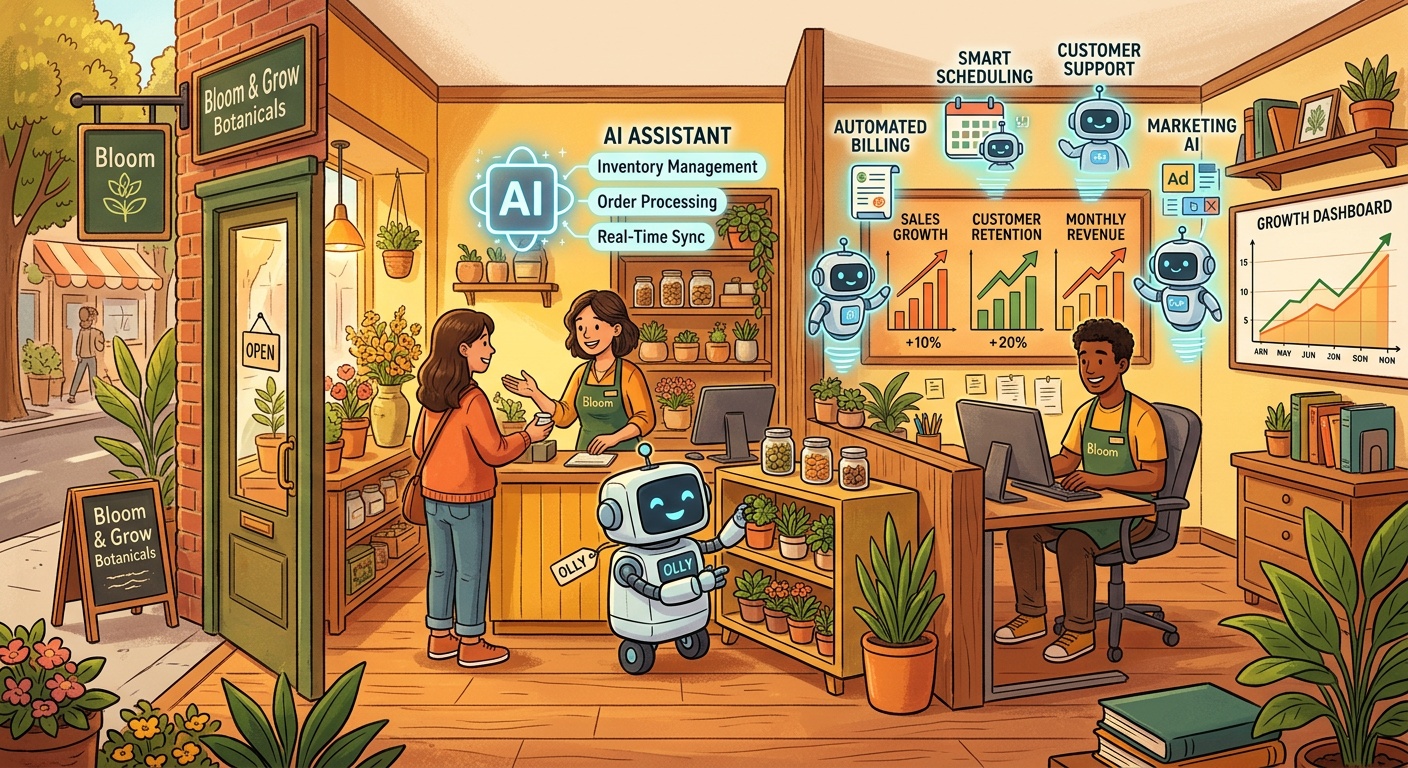
The most effective AI automation for small business targets high-volume, repetitive tasks that do not require deep human judgment.
Customer service automation is the top use case because it directly impacts revenue: studies show that 75% of consumers prefer businesses that offer quick, automated responses to common questions.
Sales automation is second: AI tools that research prospects, send follow-ups, and update CRM records can save a solo salesperson 10-15 hours per week.
Bookkeeping automation is third: categorizing transactions, generating invoices, and reconciling accounts are tasks that AI handles with near-perfect accuracy.
Content marketing automation is fourth: drafting social media posts, blog outlines, and email newsletters from your notes.
Our guide on AI agents for small business breaks down the exact ROI for each automation category.
What the Data Says About Small Business AI ROI

PwC’s 2026 AI Business Predictions found that companies using AI automation reported 66% productivity gains and 57% cost savings.
For a small business, a 66% productivity gain means you can either grow without hiring or maintain current operations with significantly less effort.
Gartner projects the agentic AI market at USD 93.2 billion by 2032, growing at 44.6% CAGR.
The growth is driven partly by small business adoption, which is accelerating faster than enterprise adoption because small businesses can deploy tools without months of procurement and compliance reviews.
MIT’s Project NANDA found that 95% of custom-built agent projects failed, but buying proven AI tools from specialized vendors succeeded 67% of the time.
For small businesses, the message is clear: buy AI automation tools, do not try to build them.
Learning how to build and deploy AI agents is a skill that pays for itself within the first month of use.
The Practical Starting Point
AI automation for small business does not require a six-figure budget or a technical team.
Start by listing every task you or your team does more than three times per week.
Pick the most repetitive one that takes the most time.
Search for an AI tool that automates that specific task.
Set it up in one afternoon.
BCG found that only 5% of companies capture significant AI value, and the ones that do share one trait: they started small, measured everything, and expanded from proven wins.
The best AI agents for business automation are affordable enough that the cost of trying and failing is negligible compared to the cost of never trying at all.
The Bottom Line for Small Business Owners
AI automation for small business in 2026 is not a speculative future technology.
It is a proven operational advantage that the majority of your competitors are already using.
The SBE Council found that the typical small business runs on 5 AI tools.
If you are below that average, you are operating at a structural disadvantage.
The tools are cheaper than hiring, faster than manual processes, and more accurate than human effort on repetitive tasks.
The only question left is when you will start.